
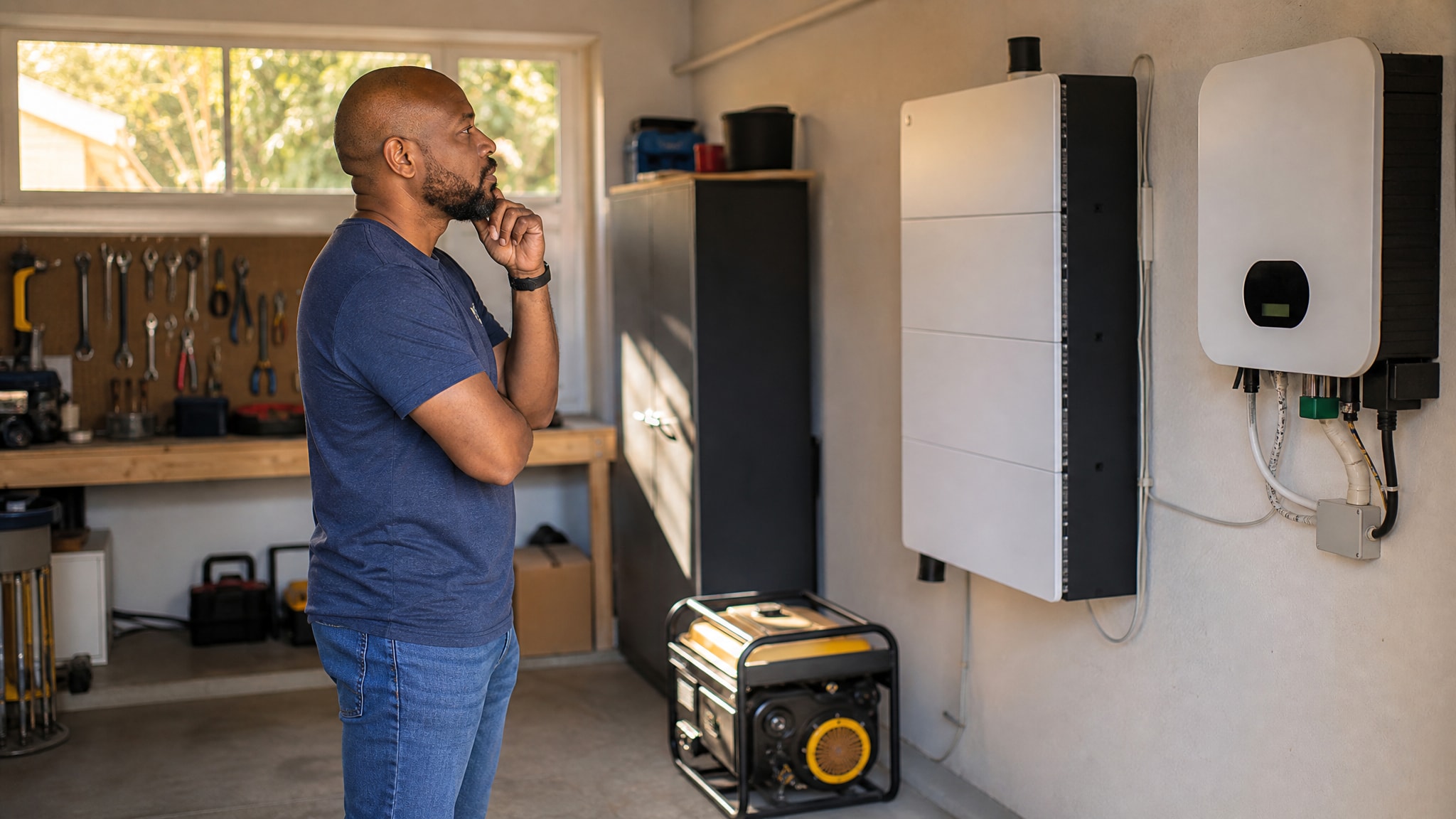
Load shedding has moved from a temporary crisis to a permanent line item in South African household budgets. Property owners now have to choose between competing backup power options. The decision often narrows down to solar vs generator in South Africa, but comparing them means looking past the initial price tag to total cost of ownership, reliability during extended outages, and long-term asset value. Generators offer a familiar entry point. Modern battery storage systems have shifted the economic calculus for homeowners planning beyond the next tariff hike.
Upfront Costs vs Long-Term Value in 2026
The sticker shock of a complete renewable energy system remains the primary barrier for many households. Even so, that capital expenditure buys an appreciating asset rather than a depreciating machine. Weigh the immediate cash flow impact against decades of avoided utility spend when you decide which system actually serves your finances over the next ten years.
Initial Investment for Solar Battery Systems
A quality hybrid inverter and lithium iron phosphate battery bank demands a significant upfront commitment, typically R150,000 to R300,000 depending on capacity and brand. That price includes professional installation, compliance certificates, and smart monitoring hardware that integrates with your existing distribution board. According to battery manufacturer specifications, modern lithium iron phosphate batteries now offer 6,000+ cycles at 80% depth of discharge, which is why they work for daily load shedding use and not just emergency backup. That cycle life works out to roughly fifteen years of daily cycling before capacity drops to replacement levels, spreading the capital cost across thousands of charge events.
Generator Purchase and Installation Expenses
Petrol or diesel generators are a far lower barrier to entry. Portable units that run essential loads sell for under R20,000, and larger standby models start around R60,000. Installation costs stay modest compared to solar, often needing only a changeover switch and basic weatherproofing rather than complex electrical integration. That affordability makes combustion backup attractive for renters or anyone unsure how long they’ll stay at a property. But treating a generator as a permanent solution ignores the operational expenses that build up quietly over months of stage 4 and stage 6 outages.
Generator Running Cost South Africa vs Solar Savings
South African petrol prices have risen significantly since 2023, and that has made generator fuel costs increasingly volatile for anyone relying on combustion engines through prolonged grid failures. Your monthly energy budget becomes hard to forecast when it depends on international crude markets and local refinery disruptions rather than predictable solar irradiance.
Fuel Price Volatility and Consumption Rates
Running a 5kVA petrol generator at half load burns roughly two litres per hour. That sounds manageable until you multiply it by six hours of daily load shedding across thirty days. At current pump prices, a single month of stage 4 relief can easily top R3,500 in fuel alone, excluding oil changes, spark plugs, and the engine service intervals manufacturers mandate every fifty hours. Diesel variants improve efficiency slightly, but fuel storage challenges and higher maintenance complexity eat into those savings during extended outages. By 2026, the real running cost of a generator through stage 4 to stage 6 load shedding often surpasses what most homeowners budgeted when they bought the unit during calmer grid conditions.
Zero-Fuel Economics of Solar Backup Power
Once installed, a solar battery system turns sunlight into usable electricity with no marginal cost per kilowatt-hour. That decouples your backup capability from commodity price swings entirely. The solar backup power comparison favours renewable systems decisively once the initial payback period ends, typically within four to seven years depending on your consumption patterns and tariff structure. Every hour of sunshine after that point is pure savings, compounding as Eskom tariffs keep climbing. This zero-fuel model turns your roof into a productive asset, one that earns its keep whether the grid is up or down.
Reliability During Extended Load Shedding Stages
Mechanical backup systems depend on supply chains that themselves fail during national crises. The cruel irony: your generator runs dry precisely when you need it most. A correctly sized battery system removes that single point of failure by storing energy locally, independent of fuel delivery logistics that buckle under pressure.
Battery Autonomy Through Stage 6 Outages
Modern hybrid systems paired with an adequate PV array can sustain essential household loads indefinitely through stage 6 load shedding, provided the system was designed for autonomy rather than mere supplementation. Garden Route homeowners facing stage 6 load shedding have reported fuel shortages at local stations, leaving generator owners unable to keep power running through the worst outage periods, exactly when municipal infrastructure is straining too. Your battery doesn’t queue at a petrol station or wait on a tanker delivery. It cycles stored energy each night and tops up during daylight hours regardless of grid status. Can a solar battery system reliably carry a household through extended outages without grid support? Yes, if the array and storage are sized for worst-case winter irradiance rather than optimistic summer averages.
Generator Fail Points and Fuel Logistics
Combustion engines contain hundreds of moving parts that vibrate, heat up, and wear down with every hour of operation. That mechanical failure risk climbs fast during marathon outage sessions. Fuel degradation is another hidden vulnerability: petrol stored for more than three months loses volatility and gums up carburettors unless treated with stabilisers, which adds yet another recurring cost. Sourcing fresh fuel during stage 6 turns into a logistical nightmare once traffic lights fail and stations run dry, turning your backup plan into a liability exactly when resilience matters most. These cascading failure modes make generators a poor primary backup for properties that can’t tolerate interruption during severe grid instability.
Noise, Emissions and Neighbourhood Impact
Silent operation is what separates inverter-based systems from their combustion counterparts, and it affects both quality of life and property relationships in dense residential estates. Your neighbours will notice the difference immediately. So will your body, trying to sleep through a four-hour outage with a mechanical drone coming through the bedroom window.
Generators produce between 70 and 90 decibels of continuous noise that travels easily through walls and fences, violating municipal noise bylaws and straining community relations in shared living environments. Beyond the noise, exhaust fumes carry carbon monoxide and particulate matter that pose health risks when units run near open windows or ventilation intakes. Inverter systems generate zero emissions and run silently, so you can keep the power on through the night without disturbing anyone or fouling indoor air. That environmental and social compatibility matters more each year, as estates tighten restrictions on combustion equipment and residents weigh livability alongside resilience.
Maintenance Requirements and System Lifespan
The gap between diesel generators and modern hybrid inverters comes down to active mechanical servicing versus passive electronic monitoring that asks almost nothing of the owner. Generators need oil changes, filter replacements, valve adjustments, and periodic load testing to stay reliable. Solid-state solar electronics just sit there converting energy, with no consumables and no scheduled downtime.
Servicing Intervals for Diesel Generator vs Inverter
Manufacturers typically call for generator servicing every 50 to 100 running hours. During heavy load shedding stages, that means quarterly technician visits plus parts you have to source and store yourself. Skip these intervals and you void warranties and accelerate wear; keep to them and you add thousands of rands a year to your total cost of ownership, on top of fuel. Hybrid inverters and lithium batteries need virtually no scheduled maintenance beyond occasional firmware updates and an annual electrical inspection to check connections and performance. That maintenance gap compounds over five years: generator upkeep can run R15,000 to R25,000 in labour and parts, while solar systems cost far less to service.
Warranty Coverage and Component Replacement
Quality lithium battery manufacturers now warrant their products for ten years or 6,000 cycles, reflecting how far the chemistry has come past early-generation lead-acid technology. Generator warranties typically cover one to two years or a limited number of running hours, since mechanical systems wear down predictably no matter how well they’re built. When a generator fails outside warranty, repair costs often approach the price of replacement. Modular solar systems, by contrast, allow component-level repairs that preserve most of your investment. Everlife Group installs solar battery systems and maintains properties across the Garden Route, which gives it a direct view of how building condition affects energy system performance and longevity.
Choosing the Right Backup Power Options South Africa
No single solution fits every property. An honest assessment means matching your load profile, budget, and tolerance for operational complexity against what’s actually available. Some large estates with high base loads may still need hybrid configurations, but most residential users do better with pure solar-plus-storage systems built for daily cycling.
Hybrid Solutions for High-Load Properties
When might a hybrid solar-generator setup make sense instead of a standalone solution? Properties with sustained loads above 8kW continuous, such as those running borehole pumps, workshop equipment, or extensive irrigation systems, may benefit from generator backup during extended cloudy stretches. In these cases the generator is tertiary backup, not the primary power source, running only when battery reserves drop below safe thresholds during multi-day storms. This setup cuts fuel consumption dramatically compared to generator-only systems while keeping resilience in reserve for the exceptional circumstances pure solar can’t economically cover.
Assessing Your Household Energy Profile
Start with a detailed load audit that separates the circuits you absolutely need during outages from the loads you can shed temporarily. Budget follows from that: put capital toward battery capacity first and PV array expansion second, since stored energy matters more than generation potential during winter months when irradiance drops. Your tolerance for fuel logistics and maintenance effort then decides whether a generator belongs in the mix at all; most urban households find that pure solar removes the operational friction entirely. Professional assessment keeps you from overspending on capacity you’ll never use, or undersizing a system that fails when you need it most.
Protecting Your Energy Investment Through Property Care
A solar installation is only as durable as the building it sits on. Roof integrity and electrical safety are the foundation of reliable backup power. Waterproofing failures, corroded flashings, and degraded paint systems can compromise mounting structures and open up leak paths that damage the expensive electronics underneath. Regular high-pressure cleaning of panels keeps generation efficiency up, and broader property maintenance keeps your energy asset performing for its full design lifespan.
Everlife Group pairs sustainable energy work with building maintenance, including painting, waterproofing, and renovations, so your investment is protected as a whole rather than treated as separate from the structure that holds it up. Request a personalised backup power assessment that looks at both your energy needs and your property condition, so your system delivers reliable performance for decades.