
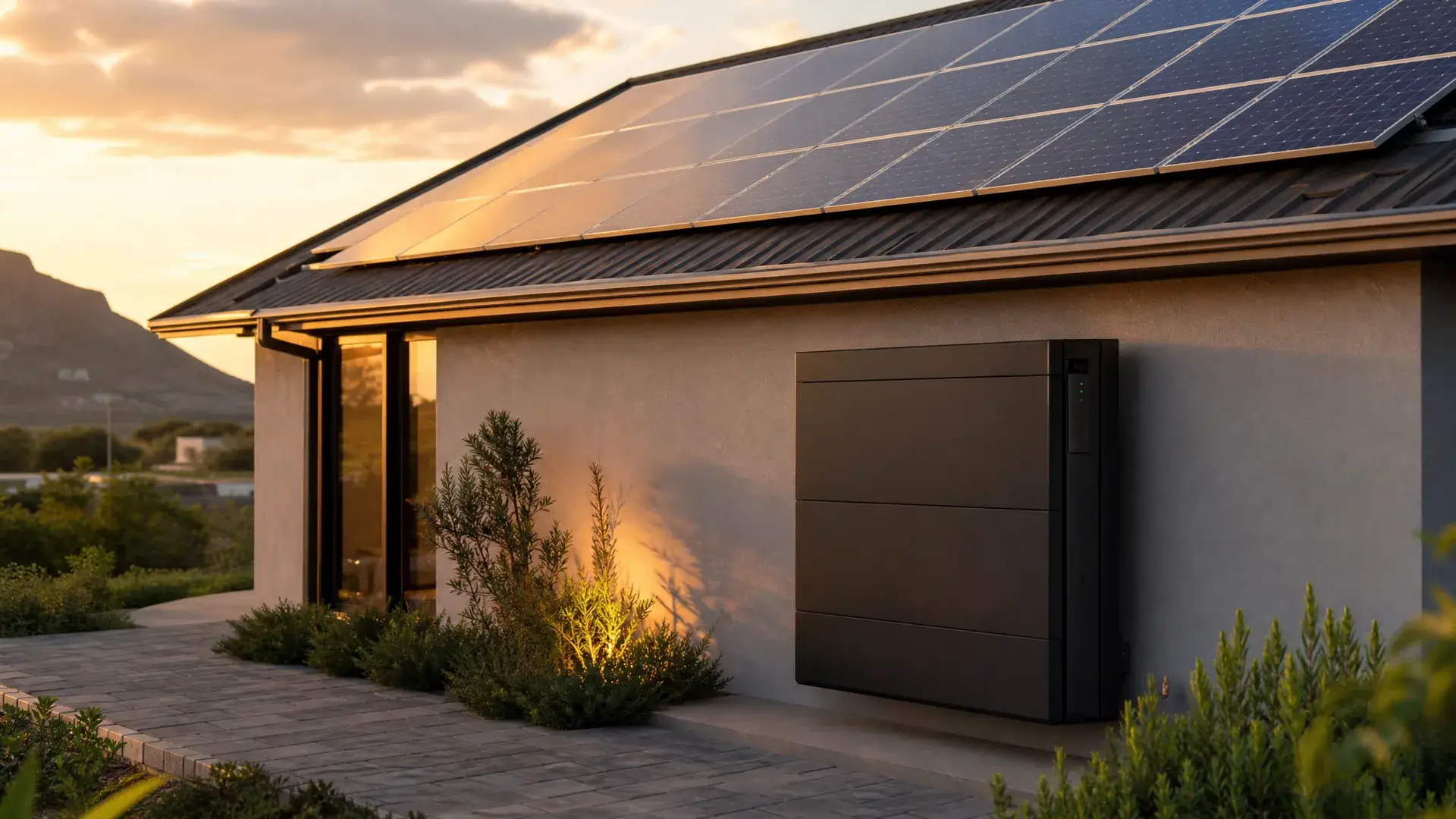
Finding the best solar battery storage south africa has to offer is no longer a niche concern for early adopters. After years of escalating load-shedding and Eskom tariff hikes that consistently outpace inflation, reliable battery backup has become a practical necessity for homes and businesses across the country, including the Garden Route. A solar panel array is a strong start, but without storage, you’re only generating energy when the sun shines. A well-matched battery system is what turns that daytime generation into genuine 24-hour energy independence.
Why Solar Battery Storage Matters in South Africa Right Now
South Africa’s grid instability has reshaped how homeowners and businesses think about energy. Stage 4 and Stage 6 load-shedding schedules became routine in recent years, and the grid cannot be trusted as a reliable primary source. Eskom’s residential tariffs have also risen sharply over the past decade, making every unit of self-generated solar energy more valuable than the year before.
Battery backup power south africa buyers are now evaluating is no longer a convenience layer. When outages run up to 8 hours a day, a battery system is the critical link between a solar array and a home or business that keeps functioning after dark, through the night, and into the next morning cycle.
What to Look For in a Solar Battery System: Key Selection Criteria
Not all battery specifications translate into real-world performance. Three criteria matter most when comparing solar battery systems south africa conditions demand.
Storage Capacity and Usable Energy
A battery’s rated capacity and its usable capacity are not the same number. Most lithium batteries discharge to around 80–90% of their rated capacity without harming the cells, so a 10 kWh battery delivers 8–9 kWh of usable energy. Lead-acid batteries are typically limited to 50% depth of discharge, meaning a 10 kWh lead-acid bank delivers just 5 kWh before damage risk increases.
For South African households, a useful sizing benchmark is this: surviving Stage 4 load-shedding, up to 8 hours of grid outage per day, while keeping essential circuits running through the night generally requires at least 10–15 kWh of usable capacity. That figure is significantly higher than battery sizing common in European grid-backup installations, where outages are rare and short.
Round-Trip Efficiency and Real-World Output
Round-trip efficiency measures how much of the energy you put into a battery you actually get back out. A battery with 95% round-trip efficiency returns 95 kWh for every 100 kWh charged. A lower-efficiency system wastes more energy as heat, which matters more in South Africa’s warm climate, where ambient temperatures are already pushing thermal limits.
Lithium battery storage solar configurations consistently outperform lead-acid on this metric. Quality LiFePO4 (lithium iron phosphate) systems typically achieve round-trip efficiencies above 95%, while flooded lead-acid batteries often fall below 80%. That gap compounds over years of daily cycling. In a high-cycling environment like South Africa’s, the difference in real-world output is substantial.
Warranty, Cycle Life, and Durability in SA Conditions
A 10-year battery warranty sounds reassuring, but the detail that matters is the cycle count guarantee alongside it. A battery warranted for 6,000 cycles at 80% depth of discharge will comfortably outlast one guaranteed for only 3,000 cycles, especially under South Africa’s daily cycling demands, where a battery may be fully discharged and recharged every single day.
In the Garden Route specifically, coastal humidity and summer heat add stress to enclosures and battery management systems. These are factors energy storage solutions SA buyers must account for: a battery correctly specified for the local environment, with appropriate ventilation and IP-rated enclosures, will dramatically outperform one installed without regard for those conditions.
The Best Solar Battery Storage Options for South Africa in 2026
The South African market has matured considerably, and buyers now have access to well-proven chemistries and brands with local track records.
Lithium Iron Phosphate (LiFePO4), The SA Climate Winner
LiFePO4 is the chemistry of choice for the South African residential and commercial market. It offers superior thermal stability compared to NMC (nickel manganese cobalt) lithium chemistries, handles high ambient temperatures more safely, and degrades less over time. It is also inherently more stable chemically, making thermal runaway far less likely, a meaningful safety advantage in home installations.
Brands such as Pylontech, BYD, FreedomWon, and BlueNova are widely recognised in the South African market. FreedomWon and BlueNova are locally designed and assembled, giving them product specifications informed by SA grid and climate conditions. All four have established installer networks and local warranty support, a factor that becomes critical the moment a battery management system (BMS) fault or inverter compatibility issue arises.
Lead-acid and gel batteries remain available at lower upfront cost, but their shorter cycle lives, lower usable capacity, and heat sensitivity make them a poor long-term investment in South African conditions.
High-Capacity Systems for Commercial and Business Use
Commercial buyers face a different sizing challenge. Beyond keeping the lights on during load-shedding, businesses moving onto Eskom’s time-of-use tariff structures can use battery storage to reduce peak-demand charges, storing cheap off-peak energy and discharging during expensive peak windows. That dual benefit, load-shedding resilience plus demand-charge arbitrage, delivers a financial return that residential payback models don’t fully capture.
Modular, stackable battery systems are the practical choice here. Pylontech and BYD both offer stackable rack-mounted units that scale from small commercial sites up to large installations. This lets businesses start at a manageable capacity and expand as energy needs grow or budgets allow, without replacing the entire system.
Solar Battery Storage Performance in the SA Climate
This is the dimension that most global brand comparisons overlook. A battery system benchmarked for northern European conditions, infrequent outages, mild temperatures, low humidity, is not the same product in the Garden Route’s summer heat and coastal air.
High ambient temperatures accelerate chemical degradation inside battery cells. Most lithium batteries are rated for optimal performance at 20–25°C; sustained operation above 35°C shortens cycle life. South Africa’s interior regions routinely exceed these temperatures in summer, and even the Garden Route’s coastal climate delivers consistent warmth that a battery system must manage continuously, not seasonally.
Coastal humidity introduces a separate concern: condensation and salt-laden air can corrode terminals and degrade enclosures over time. Correct installation, IP-rated battery enclosures, adequate ventilation, and placement away from direct sunlight, is not optional in these environments. It is the difference between a system that performs for 10 years and one that degrades in five.
Then there is the cycling stress unique to South Africa. In most global markets, a home battery cycles once every few days as a grid-backup insurance product. In South Africa, daily full discharge-and-recharge cycles are normal under active load-shedding. That pattern accumulates cycle count at a rate European or American use-case models don’t account for, making cycle life guarantees and BMS quality far more important selection criteria here than they are elsewhere.
Costs, Savings, and Payback: What South African Buyers Should Expect
Pricing for battery storage in South Africa spans a wide range depending on capacity, chemistry, and installation complexity. Entry-level home storage systems, sufficient to run essential circuits through a standard load-shedding window, sit at a meaningfully lower price point than full solar-plus-storage packages. Larger commercial installations scale significantly higher, reflecting both capacity and the additional engineering required for safe integration.
Understanding solar panel system costs in South Africa alongside battery pricing gives buyers the complete picture of what a full system investment looks like and what it delivers.
The payback case is driven by several converging factors. Eskom tariffs have risen consistently and show no sign of stabilising, so every kWh of self-consumed solar energy is worth more each year. Businesses that previously relied on diesel generators during load-shedding can realise significant fuel cost savings by switching to solar-plus-storage. And as time-of-use tariffs extend to more Eskom customer segments, the arbitrage opportunity grows further.
Payback periods vary by system size, consumption pattern, and tariff structure. But the direction of travel is consistent: rising grid costs make the investment case stronger over time, not weaker.
Local Support and Installation: Why It Matters as Much as the Battery Brand
A globally recognised battery brand means little if there is no competent local support when something goes wrong. BMS faults, inverter compatibility mismatches, and firmware issues are real-world events, and resolving them requires a qualified installer who knows the product, can access replacement components locally, and is reachable after installation.
This is where many South African buyers discover the gap between buying a battery online and investing in a supported energy system. Warranties honoured only through overseas manufacturers, or by distant distributors with long lead times, leave buyers without power and without recourse during exactly the situations storage was meant to solve.
Local, certified installation matters from day one. Correct cable sizing, proper earthing, adequate ventilation, and accurate BMS configuration all affect both performance and safety. A rushed or uncertified installation can void a manufacturer warranty entirely.
Everlife Group operates from the Garden Route and designs energy storage solutions built specifically for local climate conditions, coastal humidity, summer heat, and SA’s daily cycling demands included. Every installation includes post-installation monitoring and ongoing support, so clients have a long-term partner rather than a one-time supplier.
If you’re ready to move from uncertainty about load-shedding to reliable, solar-powered energy independence, contact Everlife Group for a free, no-obligation battery storage assessment tailored to your home or business. We’ll size the right system for your actual needs and back it up with local expertise that’s here when you need it.