
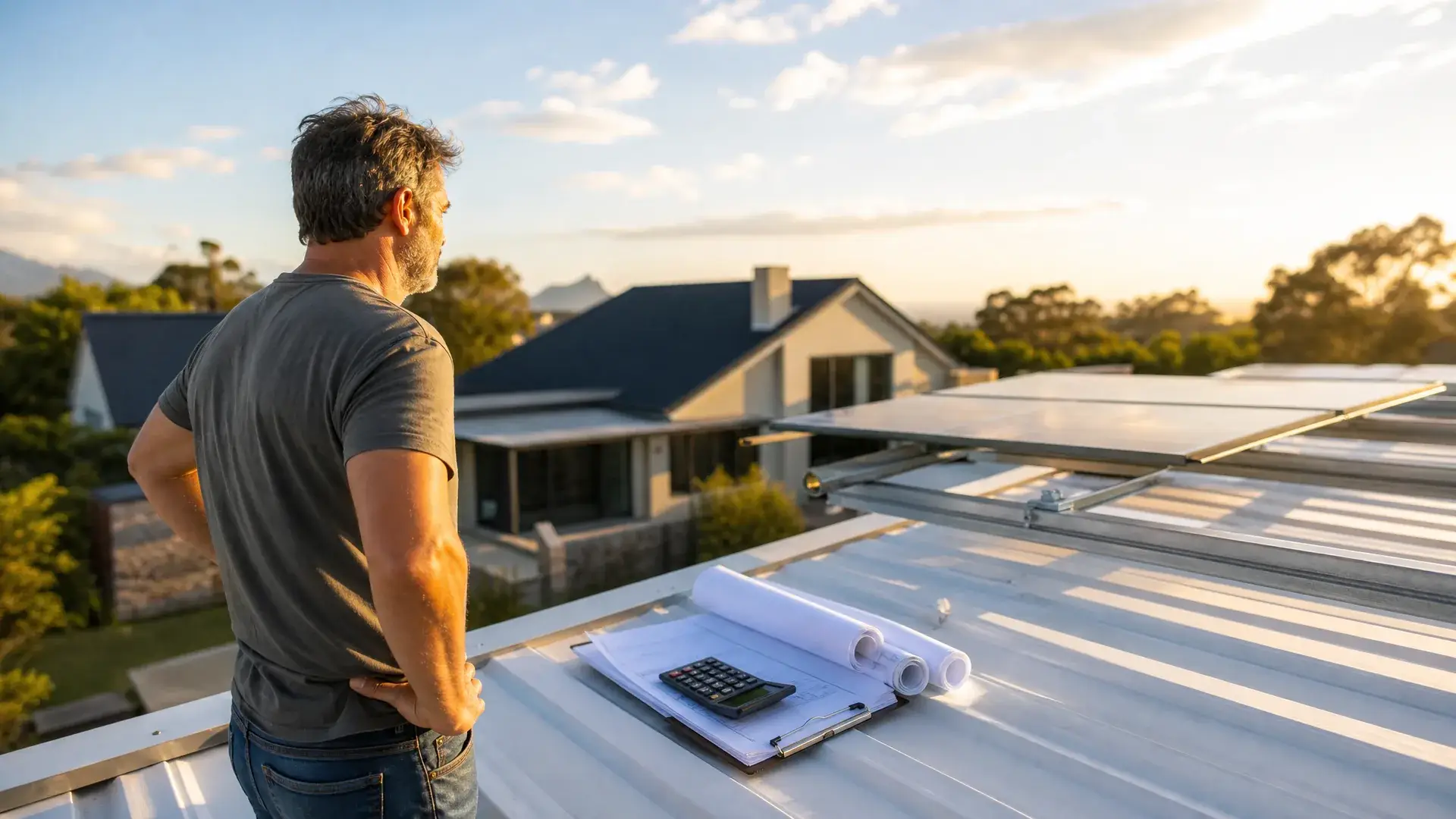
South Africa’s energy situation in 2026 has made one thing clear: waiting for grid reliability is not a strategy. Persistent load-shedding, Eskom tariffs that have risen sharply over the past decade, and a tax environment that actively rewards renewable investment have pushed solar to the top of the agenda for homeowners and businesses alike. The single biggest obstacle keeping people off solar is upfront cost, and that’s exactly where solar financing options in South Africa need to be better understood. This guide maps every major financing path available right now, so you can find the one that fits your situation and move forward.
Before choosing a finance structure, it helps to understand what solar panels cost in South Africa, because the financing terms you need depend heavily on the system size you’re funding.
Why Solar Financing Has Never Been More Relevant in South Africa
Eskom’s tariff trajectory has made grid electricity progressively more expensive, and the pattern shows no sign of reversing. For businesses, unpredictable supply disrupts operations and erodes margins. For households, monthly electricity bills compete with every other essential expense.
The 2026 policy environment has also created genuine financial incentives to act. The Section 12B accelerated depreciation allowance gives qualifying businesses a meaningful reduction in their effective capital outlay. Combined with falling panel prices and improving battery technology, the economics of solar have shifted decisively in the buyer’s favour.
The remaining barrier is cash flow. A quality residential installation and a commercial system both require capital that most buyers prefer not to commit in a single lump sum. That’s why understanding the full range of solar financing options matters, the right structure can make solar accessible from day one, without depleting reserves.
Solar Loan South Africa: Bank and Lender Options Explained
The most straightforward path to solar ownership is a dedicated solar loan. South Africa’s major commercial banks have all developed products targeting this market, and competition between them has improved terms considerably.
Nedbank offers both a Green Savings Bond and a dedicated green home loan product, ring-fenced financing specifically for renewable energy improvements, which means funds can only be applied to qualifying upgrades. Standard Bank, Absa, and FNB each offer green personal loans or asset finance products covering solar panel and battery installations. Beyond the big four, specialist lenders and fintech platforms have entered the solar loan market, often with faster approval timelines and more flexible credit criteria than traditional banks.
How Solar Loan Terms and Approval Work
Approval for a solar loan in South Africa follows a process similar to a standard personal or asset loan. Lenders assess credit score, income stability, existing debt obligations, and, for commercial applicants, business financials and cash flow. Most lenders require installation by an accredited installer, so working with a certified provider like Everlife Group satisfies this requirement automatically.
Loan periods typically range from 24 to 84 months, with some green home loan products extending further when tied to a property bond. Deposit requirements vary; some products offer 100% financing, while others require a contribution of 10–20% of the system cost.
The cash-flow logic is straightforward: monthly repayments on a well-structured solar loan are often lower than the Eskom bill saving the system generates from month one. That means the loan can be genuinely cash-flow positive, you pay less each month in combined loan repayment and reduced electricity costs than you were paying for grid electricity alone.
What to Watch: Interest Rates, Loan Periods, and Hidden Fees
Interest rates on solar loans are typically linked to the prime lending rate, with green-labelled products sometimes offered at a preferential margin below prime. Watch for initiation fees, monthly service fees, and early settlement penalties, these affect the true cost of borrowing more than the headline rate suggests. Always ask for the total cost of credit over the full loan term, not just the monthly instalment.
Longer loan periods reduce monthly repayments but increase total interest paid. The sweet spot for most residential customers is 48–60 months, where repayments stay manageable and total interest remains reasonable relative to the system’s 20-plus-year lifespan.
Green Financing for Solar Panels: Bonds, Funds & Government-Backed Schemes
Beyond commercial bank loans, several development finance and government-backed channels direct capital specifically toward renewable energy projects.
The Development Bank of Southern Africa (DBSA) and the Industrial Development Corporation (IDC) both operate green finance programmes that have channelled substantial capital into commercial and industrial solar projects. These programmes are generally sized for larger commercial and industrial installations rather than residential systems, but they are an important part of the financing picture for businesses looking at significant capacity.
The Small Enterprise Finance Agency (SEFA) provides funding channels for SMEs that struggle to access conventional bank finance, including for energy resilience projects. For smaller businesses in the Garden Route, SEFA is worth exploring alongside bank products.
The National Energy Regulator of South Africa (NERSA) sets the framework within which grid-tied and wheeling arrangements operate, which in turn affects the financial case for commercial solar, particularly for businesses considering selling surplus generation back to the grid or municipality.
Section 12B Tax Deduction: What It Means for Businesses in 2026
Section 12B of the Income Tax Act is the most powerful financial lever available to qualifying South African businesses investing in solar in 2026. It allows a business to deduct 125% of the cost of qualifying renewable energy assets, including solar panels and associated equipment, in the year of purchase. A R1 million installation generates a R1.25 million tax deduction, materially reducing the net effective cost of the system.
To access the deduction, the assets must be brought into use during the qualifying period and used in the production of income. The deduction applies to owned assets, so it works alongside bank loans or cash purchases, not with lease or PPA structures where the installer retains ownership.
For businesses evaluating the full financial picture, pairing the Section 12B benefit with a commercial solar ROI and cost breakdown makes the decision considerably clearer. The effective payback period shortens significantly once the tax saving is factored in.
Solar Payment Plans in South Africa: Lease, PPA & Rent-to-Own Models
Not every buyer wants or qualifies for a loan. Zero-upfront solar payment plans have grown significantly, giving homeowners and businesses a way to go solar without capital expenditure.
Three main models exist:
Operating lease: The installer owns the panels throughout the agreement. The customer pays a fixed monthly fee to use the system. There is no path to ownership at the end of the term unless a purchase option is exercised. This model suits customers who want predictable costs and no maintenance responsibility.
Power Purchase Agreement (PPA): The customer pays per kilowatt-hour generated, at a fixed rand-per-kWh rate, typically set below the current Eskom commercial tariff. The installer funds, installs, and maintains the system. Large South African retailers, hospitality groups, and municipalities have used PPAs extensively to eliminate capital expenditure while locking in below-tariff electricity costs.
Rent-to-own / lease-to-own: Monthly payments build equity in the system. At the end of the agreement term, ownership transfers to the customer. This is the zero-upfront model best suited to residential customers and smaller businesses that want eventual ownership without a large deposit.
For system scoping, remember that many financed packages bundle battery storage, understanding the best solar battery storage options in South Africa helps you plan for the full system before committing to a payment structure.
Power Purchase Agreements vs. Lease-to-Own: Key Differences
The core distinction is ownership and cost structure. Under a PPA, you never own the panels, but your electricity cost is predictable and typically lower than Eskom from day one. Under a lease-to-own agreement, you pay a fixed monthly amount and build toward full ownership, combining the cash-flow benefit of zero upfront with the long-term equity of outright purchase.
PPAs tend to suit large commercial users with high and consistent energy consumption, where per-kWh savings across a large load justify the long-term agreement. Rent-to-own suits residential customers and smaller businesses who want affordable solar now and full ownership later.
Comparing Solar Financing Options: Which Path Fits Your Situation?
| Financing Path | Ownership Outcome | Monthly Cost Predictability | Eligibility Complexity | Best Fit |
|---|---|---|---|---|
| Bank / lender solar loan | Full ownership from day one | Fixed repayment | Moderate, credit-dependent | Homeowners and businesses with good credit wanting immediate ownership and Section 12B access |
| Green bond / development fund | Full ownership | Varies by product | Higher, requires qualifying project size | Commercial and industrial users; SMEs via SEFA |
| Operating lease | No ownership | Fixed monthly fee | Low, minimal credit requirement | Customers prioritising simplicity and low commitment |
| PPA | No ownership | Variable (per kWh) | Low to moderate | Large commercial users with high, consistent consumption |
| Rent-to-own | Ownership at end of term | Fixed monthly payment | Low to moderate | Residential and small business customers wanting eventual ownership with zero upfront |
The right path depends on three questions: Do you want to own the system? Can you access credit? And do you qualify for the Section 12B deduction? Answering those three narrows the field quickly. Factor in ongoing solar panel maintenance costs when comparing total cost of ownership across models, since maintenance responsibility differs between ownership and lease structures.
How to Get Started With Affordable Solar Installation in the Garden Route
Navigating lenders, comparing products, and matching a financing structure to your specific situation takes time, and most people do it without a guide. Everlife Group works differently. We serve residential and commercial clients across the Garden Route as a single end-to-end partner: site visit, system sizing, financing match, installation, and aftercare under one roof.
The process starts with a free energy assessment. We assess your current consumption, roof or ground-mount potential, and grid connection, then size a system that genuinely meets your needs, not the largest system we can sell. From there, we match your profile to the financing path most likely to be approved and most cost-effective for your situation, whether that’s a green home loan, a rent-to-own structure, or a commercial PPA.
We work directly with lenders and can guide you through the paperwork, reducing the friction that causes most solar projects to stall between intention and signature.
If you’re ready to understand which solar financing options are available for your property or business, and which one makes the most sense, the next step is straightforward. Request a free energy assessment or financing consultation with Everlife Group today. One conversation can take you from uncertainty to a clear plan, with monthly costs you can model against your current electricity bill before you commit to anything.