
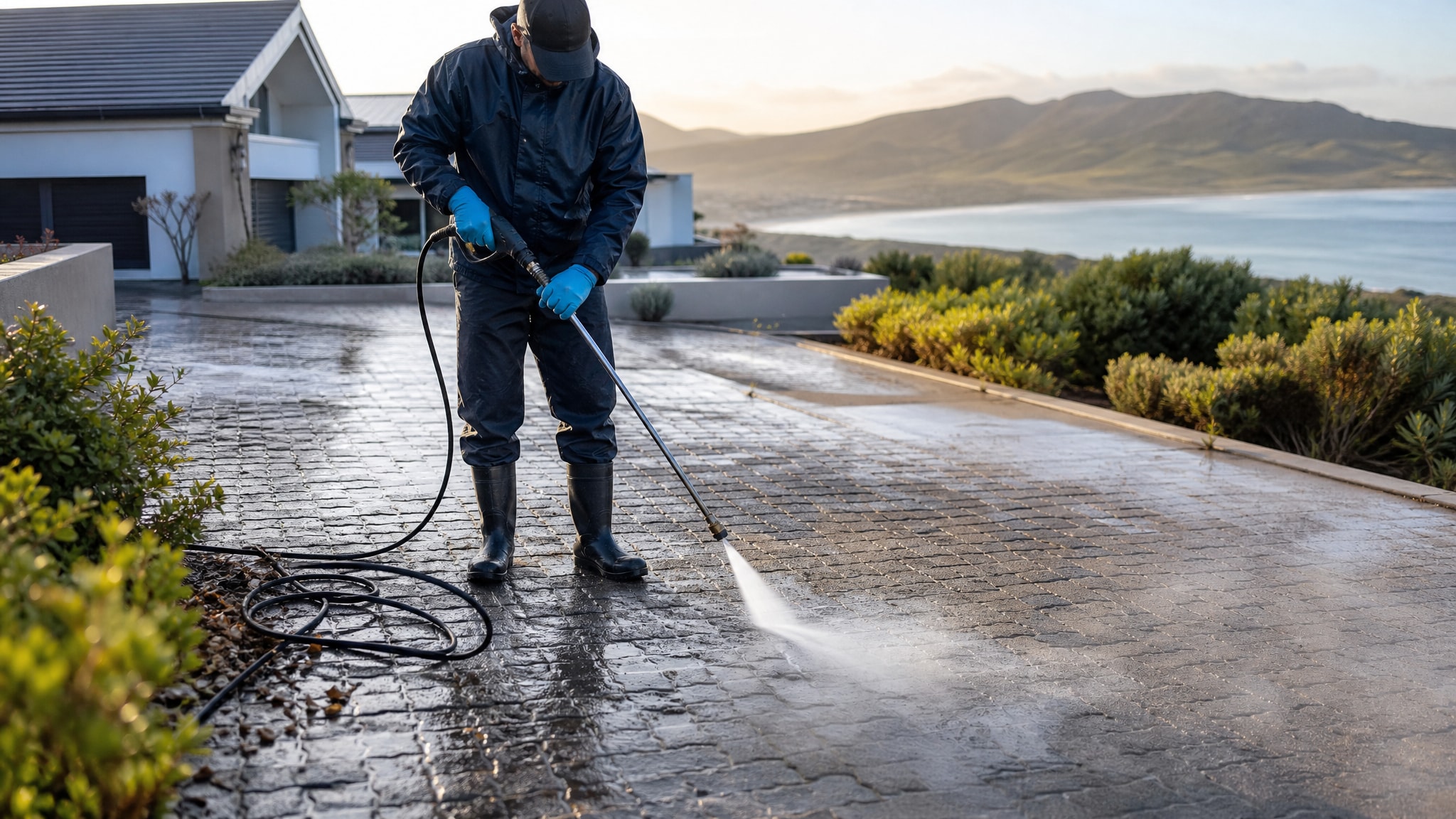
A clean driveway signals a well-maintained property, but in the Garden Route, keeping paved surfaces presentable takes more than occasional sweeping. Salt spray, fynbos debris and seasonal dampness create cleaning challenges that standard maintenance routines often miss. Understanding the true high pressure cleaning driveway cost helps you budget for this upkeep instead of reacting once surface damage is already visible.
Property owners often underestimate how much local conditions affect both the frequency and the complexity of driveway maintenance. Your paving needs care calibrated to coastal exposure, not a generic national average that ignores regional realities.
Average High Pressure Cleaning Driveway Cost in South Africa
Pricing for driveway cleaning varies across the Western Cape because contractors have to account for travel distances between towns, plus the specific equipment each surface demands. Expect quotes to reflect these operational realities rather than the flat rates advertised for inland metros, where logistics are simpler and contamination levels differ.
Price Per Square Metre by Surface Type
Concrete driveways typically sit at the lower end of the pricing spectrum. Their uniform surface allows for faster mechanical cleaning with standard rotary equipment. Pavers take considerably more time and specialized technique, which pushes the per-square-metre rate higher, since crews need to protect joint integrity while removing embedded grime. Asphalt falls somewhere in between, though it needs lower pressure settings so summer heat doesn’t let the pressure dislodge aggregate or soften the bitumen binder.
Porosity drives labour time and chemical use on any given project. A smooth concrete slab releases oil stains and biological growth far more readily than textured clay pavers, which trap contaminants deep in their surface profile. That means longer dwell times for cleaning agents and multiple rinse passes to get an acceptable result.
Minimum Call-Out Fees and Small Area Surcharges
Professional cleaning services generally charge a minimum call-out fee to cover travel and setup. That fee makes small driveways proportionally more expensive per square metre than larger ones. It covers fuel, equipment transport and crew mobilisation whether the job takes two hours or six, so combining your driveway clean with other exterior maintenance often delivers better overall value.
Small area surcharges apply when total square footage falls below a contractor’s threshold for deploying specialized machinery. Rather than pay a premium for an isolated driveway wash, consider scheduling it alongside gutter cleaning or wall washing to spread the fixed costs across multiple tasks.
Factors Influencing Paving Cleaning Cost and Quotes
Several variables decide whether your outdoor cleaning quote lands at the baseline rate or climbs toward the upper tier for complex restorations. Knowing these factors before you request estimates helps you read the differences between contractors and understand what’s driving legitimate cost variation.
Severity of Algae, Oil, and Rust Stains
Heavy biological growth or deep-set oil stains add labour time and chemical use, pushing the driveway pressure wash price beyond standard per-metre calculations. A neglected surface that has built up years of organic matter may need pre-treatment and extended agitation cycles that double the time compared with regularly maintained paving.
Rust stains from irrigation systems or vehicle leaks are their own problem: they penetrate porous materials and resist standard alkaline cleaners. Specialized acidic treatments add to material costs and need careful neutralizing afterward, so they don’t damage nearby plants or building finishes.
Access Restrictions and Water Availability
Tight access that keeps equipment from reaching the work area forces crews onto manual methods or smaller machines that run less efficiently. A narrow side passage, a steep gradient, or a built-in planter all extend setup time and cut into productive cleaning hours, and contractors price for that.
Water supply reliability affects both scheduling and equipment choice on Garden Route properties. A site without adequate tap pressure may need a contractor to bring buffer tanks or adjust the workflow around intermittent flow, and that logistical complexity shows up in the final quote.
Post-Clean Sealing and Joint Resanding
Sealing is often a separate line item, but it matters for long-term protection in a coastal climate where salt and moisture accelerate wear. The quoted price usually excludes sealant unless you ask for it, yet skipping the step leaves a freshly cleaned surface open to fast recontamination and UV damage.
Joint resanding is another piece that separates proper paver restoration from a superficial wash. Stabilizing sand locks the interlocking units in place and stops water infiltration that would otherwise undermine the base layer over time. It’s not an optional upgrade to a paver cleaning service; it’s part of the job.
Concrete Cleaning Cost vs. Paver Restoration Pricing
Plain concrete cleaning is a straightforward mechanical process aimed at removing surface contaminants, with no structural considerations involved. That simplicity is why concrete cleaning cost in South Africa runs lower than paver restoration, which involves more steps to protect the integrity of a modular paving system.
Paver restoration typically needs low-pressure washing combined with specialized joint stabilizing sand to prevent washout, unlike standard concrete cleaning, which uses higher PSI. That difference in technique means paver cleaning takes more labour hours per square metre even when the surface area looks identical, which is why quotes for the two differ.
Clay and cement pavers also need gentler chemical formulations, so the wash doesn’t fade colour or etch the surface. Those specialty products cost more to procure than industrial concrete degreasers, and applying them properly takes an operator trained in how different paver types react to different cleaning agents.
Joint sand’s structural role in a paver system creates an ongoing maintenance obligation that plain concrete simply doesn’t have. Every professional paver cleaning service has to address joint stability as part of the core scope. Concrete cleaning, by contrast, is done once the surface looks clean.
DIY Rental vs. Professional Outdoor Cleaning Quote
Hiring equipment looks attractive until you add up the full outlay: fuel, detergent, nozzle replacements, and the potential cost of repairing a damaged surface. Professional service fees fold in expertise and liability cover that a rental agreement doesn’t, which shifts the risk off your property and onto the contractor’s insurance.
Hidden Costs of Equipment Hire and Chemicals
Rental companies advertise daily machine rates that exclude consumables, transport fees and damage waivers, all of which inflate the real cost. Consumer-grade detergents from a hardware store lack the concentration and formulation of professional chemicals, so you may end up using three times the volume for a worse result, at retail prices.
Time is the hidden cost most DIY calculations leave out entirely. What a professional crew finishes in four hours can eat your whole weekend once you factor in the learning curve, equipment troubleshooting, and the slower pace of unfamiliar work.
Risk of Surface Damage and Warranty Voids
Wrong pressure settings can etch concrete or dislodge paver sand, turning a savings attempt into a renovation bill that costs more than professional service would have in the first place. Many paver manufacturer warranties explicitly exclude damage from untrained cleaning, so you’re fully liable for replacement if an aggressive technique compromises the surface.
Etched concrete can’t be undone with more cleaning. It needs resurfacing or replacement to look right again, and that damage happens in seconds, whenever an operator holds the nozzle too close or picks the wrong tip. Experience matters more than equipment access.
Maintenance Frequency to Protect Property Value
In coastal regions like George and Sedgefield, salt spray and organic growth accelerate surface degradation, which means more frequent cleaning cycles than an inland property needs. Most Garden Route driveways benefit from professional attention every twelve to eighteen months, before biological growth gets established and becomes harder to remove.
Waiting until a surface looks visibly dirty means the damage has already started underneath. Proactive maintenance costs less per visit, because lighter contamination needs fewer chemicals and less processing time. That spreads your annual upkeep budget across preventive visits instead of emergency restorations.
Regular cleaning extends pavement lifespan by removing the corrosive salts and acidic organic matter that slowly break down binding agents and erode surface texture. That effect compounds over years: it delays expensive resurfacing and keeps the kerb appeal that supports a property’s value at sale.
Skip scheduled maintenance and minor issues escalate into structural failures that cleaning alone can’t fix. Base layer erosion from compromised joints, or salt-induced spalling, calls for reconstruction rather than restoration, a different cost category altogether, and one regular cleaning prevents.
Getting an Accurate Driveway Pressure Wash Price
A vague inquiry gets a vague estimate, one that will need revising once the contractor sees the actual site. Detailed information upfront speeds up the quoting process and gives you a figure you can compare confidently between providers, without hidden exclusions or assumptions.
What to Include in Your Site Assessment
Accurate dimensions, current photos of the surface, and notes on known problem areas let a contractor quote precisely without an unnecessary site visit. Specify your paving type, its approximate age, and the date of the last professional clean, so the estimator can gauge contamination and pick the right method before arriving.
Mention any access limitations, water supply constraints, or nearby landscaping that could affect equipment or chemical choice. These details shape both price and scheduling, so raising them early avoids quote changes that delay the start of the job.
Combining Services for Better Value
Bundling driveway cleaning with exterior painting or waterproofing spreads the mobilisation cost and protects your investment as a whole rather than treating surfaces in isolation. Everlife Group integrates driveway cleaning with painting and waterproofing services to give Garden Route homeowners comprehensive property maintenance, on the basis that exterior surfaces work as one connected system.
Coordinating several services in a single contractor visit cuts total disruption and can qualify you for package pricing that individual bookings won’t match. Reviewing exterior house painting cost alongside your cleaning estimate can reveal savings that a standalone quote wouldn’t show.
Understanding waterproofing cost per square metre helps put driveway cleaning costs in context against broader property spending. Both services price on surface area and condition, which makes comparing them across services worthwhile for budget planning.
Why Professional Care Matters for Garden Route Properties
Driveway maintenance ties directly into broader property preservation in a Western Cape climate where environmental stress compounds year on year. Professional cleaning is one part of integrated building care that goes beyond surface looks to protect structural longevity and the value of the asset.
Everlife Group treats driveway care as part of comprehensive property stewardship, not a one-off service transaction. Our work on protecting property in the Garden Route spans energy solutions, building maintenance and exterior restoration, working together to preserve your asset’s value and function.
Request a site-specific outdoor cleaning quote and your driveway gets care calibrated to its own condition, not a generic protocol. Contact us to talk through your property’s needs and get an assessment that accounts for surface type, contamination level and your long-term maintenance plans.