
If you’ve searched for waterproofing cost per square metre in South Africa, you’ve probably found the same generic ranges repeated across a dozen sites. Most of that content is written for a national audience. It ignores the conditions that actually shape a quote in George or anywhere else on the Garden Route. Coastal humidity, salt air, and higher rainfall change what a roof needs, and that changes the price. This guide breaks down real cost drivers instead of vague averages, then shows you how to get a number you can actually trust.
Waterproofing Cost Per Square Metre in South Africa: The Real Ranges
Roof condition, access, and system choice vary so much from one property to the next that any figure you see online is a starting point, not a quote. What follows are qualitative tiers rather than fixed numbers. A proper price only comes from seeing the roof.
At the budget end, you’re usually looking at a basic single-layer application on a roof in reasonable condition with easy access. Mid-tier pricing covers more robust systems, better membrane overlap, and some prep work for minor damage. Premium pricing applies where the roof needs significant repair before waterproofing, where access is difficult, or where a higher-spec coastal system has to handle sustained rain and salt exposure.
Flat Roof Waterproofing Cost
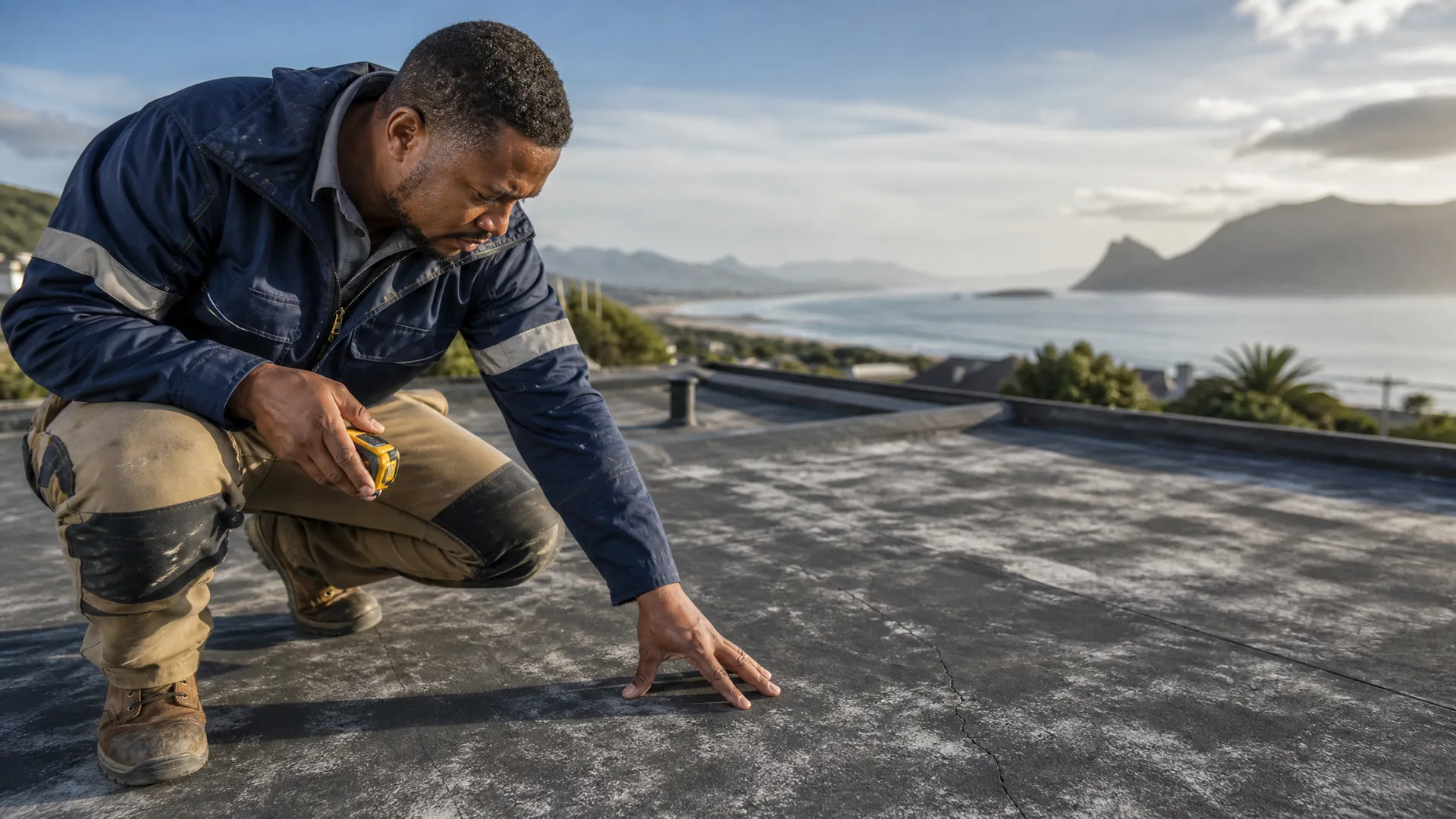
Flat roofs are among the most common waterproofing jobs on the Garden Route. Flat roof waterproofing cost depends heavily on the existing surface. A flat roof with sound concrete or screed and no ponding sits toward the lower end of the range. A flat roof with cracking, ponding water, or old failed membrane costs more per square metre, because the crew has to strip and repair before they can waterproof properly.
Size also plays a role. Smaller flat roofs carry a higher effective rate per square metre because setup, edge detailing, and parapet work take similar time regardless of area. Larger flat roofs can bring the average down slightly, assuming the surface is in reasonable shape.
Torch-On Waterproofing Price
Torch-on waterproofing price in South Africa generally sits above basic paint-on coatings. It involves heat-applied membrane sheeting, more skilled labour, and more material per square metre. It’s a durable, widely used system for flat and low-pitch roofs.
On the Garden Route specifically, torch-on jobs often need extra overlap at joints and additional drying and curing time before the roof is exposed to rain. That added labour and time shows up in the final price. It’s one reason a generic national price guide can undersell what the job actually takes in a coastal town like George.
What Actually Drives Waterproofing Price Factors in South Africa
Two roofs of the same size can come back with very different quotes. The gap almost always comes down to a handful of waterproofing price factors in South Africa: access, roof type, membrane choice, and existing damage.
Access is often the most underestimated factor. A single-storey roof reachable by a short ladder costs far less to work on than a steep, multi-storey roof that needs scaffolding or safety harnesses. Difficult access adds labour time and equipment cost before a single square metre of membrane goes down.
Roof Type and Pitch
Flat roofs and low-pitch roofs are generally more straightforward to waterproof than steep-pitched roofs, because the crew can move and work safely without extra rigging. Roof pitch also affects which membrane system is even suitable. Very steep roofs may need a different approach than a flat concrete slab, and that decision affects both material cost and labour time.
Roof shape matters too. A simple rectangular roof is quicker to waterproof than one with multiple valleys, parapet walls, pipes, and vents. All of those need careful detailing to avoid future leaks.
Existing Damage and Substrate Condition
The condition of the substrate underneath is often the single biggest swing factor in a quote. A sound, dry surface needs minimal prep. A roof with cracking, rising damp, old delaminating membrane, or rot needs repair work first, and that repair is priced separately from the waterproofing itself.
This is why two quotes for the “same” roof size can differ so much. One roof might need a light clean and prime. Another might need patch repairs, crack injection, or partial re-screeding before any membrane goes on. Skipping that prep to hit a lower price is usually a false economy. It’s the most common reason waterproofing fails early.
Liquid Waterproofing Membrane Cost vs Torch-On: Which System Fits Your Roof
Liquid waterproofing membrane cost and torch-on pricing differ because the two systems suit different roof types and levels of complexity, not because one is simply “cheaper waterproofing.”
Liquid membranes are applied by brush, roller, or spray, and they cure into a seamless, flexible coating. Torch-on systems use heat-welded sheet membrane, which creates a thick, tough barrier but needs more precise application, especially around joints and edges.
When Liquid Membranes Make Sense
Liquid membrane systems are often chosen for irregular roof shapes or areas with pipes, vents, and parapet walls, where torch-on sheeting is harder to apply cleanly. Liquid membrane conforms to detail work without seams, so it’s a strong fit for roofs with a lot of penetrations or unusual angles.
Liquid systems also suit smaller repair areas or roofs where minimal disruption matters, since there’s no open flame involved in application.
When Torch-On Is the Better Fit
Torch-on waterproofing tends to be the better fit for large, simple flat roof areas where speed and membrane thickness matter more than intricate detailing. It has a long track record on flat concrete roofs across South Africa and holds up well under sustained UV and rain exposure when installed correctly.
The right choice usually isn’t about which system is cheaper. It’s about which system matches the roof’s shape, condition, and exposure. A site inspection, not a phone call, is what determines that.
Why Coastal Garden Route Conditions Change the Waterproofing Equation
Generic national pricing guides are built around inland conditions, drier climates, and lower humidity. That’s part of why they undersell what coastal waterproofing on the Garden Route actually needs.
Everlife Group’s waterproofing crews work daily across George and the wider Garden Route, so quotes factor in coastal humidity, salt air, and higher annual rainfall that inland pricing guides ignore. Salt-laden air speeds up the breakdown of lower-grade coatings, and sustained damp conditions slow curing times during application.
Humidity, Salt Air, and Rainfall Exposure
A flat-roof torch-on application on a humid, rain-exposed George home typically needs extra membrane overlap and drying time compared to a similar job in a drier inland town. That shows up in the final price per square metre. Crews often have to work around weather windows more carefully too, since torch-on and liquid systems both need dry conditions to cure properly.
The South African Weather Service notes that the Garden Route’s rainfall pattern gives roofs more sustained water exposure across the year than many inland regions see. That raises the bar for membrane quality and detailing, particularly at joints, parapets, and roof penetrations, which are the most common failure points on coastal properties.
The Long-Term Cost of Delaying Roof Waterproofing
Putting off waterproofing rarely saves money. It usually just moves the cost further down the line, and adds to it.
Waterproofing that fails within a year or two of a poor first application usually costs more to fix than doing it properly the first time, once you factor in interior damage, mould remediation, and re-application labour. Water that gets past a compromised membrane doesn’t stay on the roof. It works into ceilings, walls, and insulation, where it causes staining, mould growth, and structural damage that’s far more expensive to repair than the roof itself.
On coastal properties, delayed waterproofing tends to compound faster. Damp conditions encourage mould growth, and salt air speeds up corrosion of any exposed metal fixings or flashing. A roof left unaddressed for another season on the Garden Route takes on more sustained rain than a similar roof inland, so the gap between “needs attention” and “needs a full repair” can close quickly.
Addressing waterproofing issues as part of broader upkeep, alongside protecting your property with painting and waterproofing, tends to be far more cost-effective than treating each problem separately once it’s escalated.
Getting an Accurate Waterproofing Quote in George
The honest answer to “how much does waterproofing cost per square metre” is that no one can tell you precisely without seeing your roof. Phone-quoted rates are a rough guide at best, because they can’t account for access, substrate condition, or the specific system your roof needs.
Everlife Group inspects existing damage, substrate condition, and access difficulty on site before quoting, rather than issuing a blanket per-square-metre rate over the phone. That’s how a waterproofing quote in George ends up matching what the job actually costs, instead of coming in low and changing once work starts.
What a Proper Site Inspection Covers
A proper inspection looks at the roof type and pitch, the condition of the existing surface, drainage and ponding issues, access requirements, and any visible signs of leaks or previous repair work. It should also account for coastal exposure, since a roof facing prevailing rain and salt air needs a different spec than a sheltered inland equivalent.
Before waterproofing begins, some roofs also benefit from high pressure cleaning before waterproofing prep, which removes debris and growth that can interfere with adhesion. If you’re weighing up contractors for the job, it helps to understand what separates a reliable operator from a risky one, covered in a separate look at choosing the right waterproofing contractor in George.
If waterproofing is one part of a larger project, it’s also worth thinking about it alongside planning a broader home renovation and upgrade, so repairs and upgrades get sequenced sensibly rather than tackled piecemeal.
If you want a number that actually reflects your roof, not a national average, request a free site inspection and quote from Everlife Group. It’s the most reliable way to know what your waterproofing will cost, and to get it done right the first time.
One Comment
[…] square metre than a multi-level structure with numerous penetrations and deteriorated flashings. A detailed waterproofing cost breakdown helps you see where your money goes and what variables move the final […]