
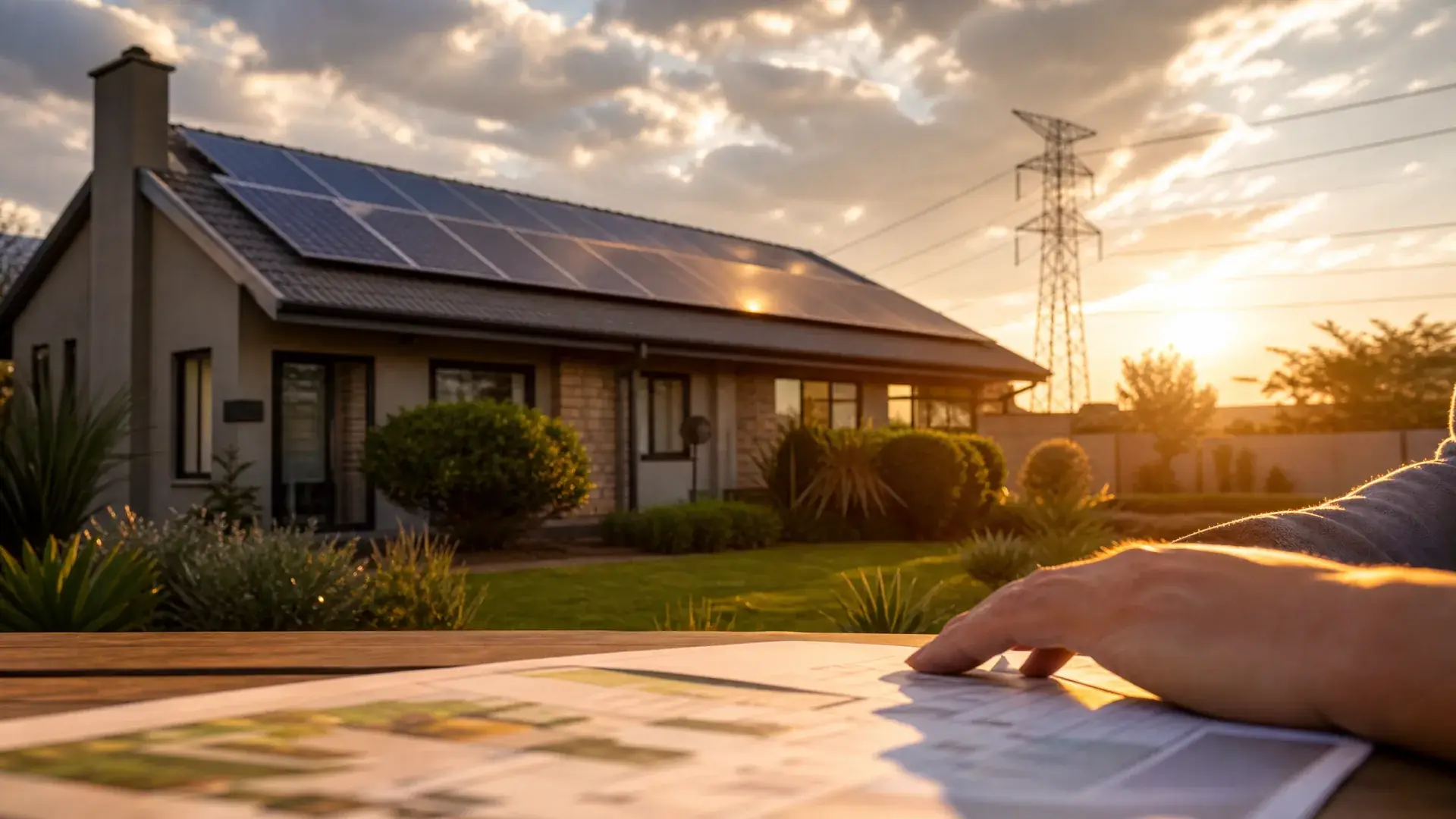
South Africa’s renewable energy tax incentive framework has never been more relevant. Eskom tariff increases have consistently outpaced inflation over the past decade, and persistent load-shedding has pushed households and businesses to act. The tax code rewards that action, but only if you know where to look. This guide breaks down Section 12B, 12BA, 12L, and 12I allowances, the personal income tax rebate for residential solar, VAT treatment, and available government financing, all in plain language, so you can make financially sound decisions before installation day.
Why South Africa’s Renewable Energy Tax Incentive Landscape Matters Right Now
Electricity in South Africa is a strategic cost, not a fixed one. NERSA-approved tariff hikes mean every rand invested in self-generation is worth more today than it was five years ago, and the after-tax cost of a qualifying solar installation drops substantially when accelerated depreciation or personal rebates are applied.
The government’s push toward a cleaner grid has produced real policy instruments, not just aspirational targets. National Treasury has introduced, extended, and enhanced several incentive mechanisms since 2023, and the 2026 tax year carries provisions that remain generous for both individual taxpayers and commercial entities.
This guide is designed to cut through the tax-code complexity. Whether you’re a salaried homeowner in the Garden Route or a business owner managing capital allocation, understanding the available incentives changes the financial case for going solar.
Section 12B and 12BA: The Core Solar Energy Tax Deduction for Businesses
The Income Tax Act No. 58 of 1962 provides accelerated depreciation on qualifying renewable energy assets through Section 12B. Its enhanced successor provisions, introduced under Section 12BA, significantly improved the write-off rate for assets first brought into use on or after 1 March 2023.
Under standard Section 12B, qualifying assets are depreciated at an accelerated rate over a compressed period rather than the standard wear-and-tear schedule. Under the enhanced 12BA provisions, a business can write off 125% of the cost of qualifying solar PV assets in the year the asset is first brought into use, turning a capital outlay into an immediate, above-cost deduction against taxable income.
A commercial property owner who installs a qualifying solar PV system can write off the full qualifying cost in the year the asset is first brought into use, turning a large capital outlay into an immediate reduction in taxable income. For those researching the financial picture, understanding what solar panels cost in South Africa is the natural starting point for sizing that deduction.
Who Qualifies: Eligibility Criteria at a Glance
To claim under Section 12B or 12BA, a business must meet several conditions:
- Asset type: The asset must be a qualifying renewable energy asset, solar PV panels, wind turbines, concentrated solar, hydropower, or biomass systems below specified generation thresholds.
- First use: The asset must be new and brought into use for the first time by the taxpayer in South Africa.
- Ownership: The taxpayer must own the asset (leased assets do not qualify under standard provisions).
- Use in trade: The asset must be used in the production of income, it cannot be purely private-use equipment.
- Capacity thresholds: The provisions distinguish between assets above and below 1 MW generation capacity, with different treatment for large-scale generation.
Hybrid solar systems that combine solar, battery storage, and grid connection are among the most commonly qualifying assets, provided the components meet the first-use and ownership criteria individually.
How the Deduction Rates Work in Practice
Under Section 12B (pre-March 2023 assets), the depreciation rate is accelerated over three years on a 50/30/20 basis, 50% of cost in year one, 30% in year two, 20% in year three. This compares favourably to the standard wear-and-tear schedule, which spreads deductions over a much longer period.
Under the enhanced 12BA provisions applicable from 1 March 2023, the 125% first-year deduction means a R2 million solar installation generates a R2.5 million deduction, directly reducing taxable income in that assessment year. The excess (R500 000 in this example) is not refunded in cash but offsets other taxable income. For a business paying the 27% corporate tax rate, the effective net cost of the system drops considerably. The commercial solar ROI and cost guide provides a fuller breakdown of how these numbers interact with installation costs and payback periods.
Section 12L Energy Efficiency and Section 12I Industrial Policy Allowances
Renewable energy generation and energy efficiency are treated as distinct, but complementary, incentives under the Income Tax Act. A business with existing solar assets can still claim under Section 12L if it is also reducing overall energy consumption.
Section 12L rewards verified energy savings with a tax deduction calculated in cents per kilowatt-hour of energy saved relative to an independently verified baseline. The measurement and verification process must follow South African National Standard (SANS) protocols, and savings must be certified by a qualified measurement and verification professional. The deduction rate has historically sat at 95 cents per kWh saved, making it meaningful for energy-intensive businesses that implement efficiency upgrades alongside or independent of renewable generation.
Section 12I: Strategic Industrial Project Incentives
Section 12I is a different instrument entirely. Administered by the Department of Trade, Industry and Competition (DTIC), it targets large greenfield and brownfield industrial investments that meet strategic criteria, typically capital-intensive manufacturing, processing, or energy projects.
Qualifying industrial projects can access an additional investment allowance (up to 55% of the cost of qualifying assets for greenfield projects in preferred locations) as well as a training allowance. The incentive is approved on a project-by-project basis before investment begins, making early engagement with the DTIC essential.
Section 12I is not relevant to residential users or typical commercial property owners. It applies to manufacturers, large-scale renewable energy developers, and industrial operators whose projects meet the qualifying investment thresholds and strategic criteria set by the DTIC. If your business falls into this category, professional tax and legal advice before capital deployment is essential, the application process is competitive and documentation-intensive.
Residential Solar Incentive Programs: The Personal Income Tax Rebate
The individual solar panel rebate, introduced for the 2023/24 tax year, gives salaried and individual taxpayers a direct credit against their personal income tax liability. For the 2026 tax year, the mechanism works as follows:
- Individuals can claim a rebate equal to 25% of the cost of new and unused solar PV panels.
- The rebate is capped at R15 000 per taxpayer per tax year.
- Panels must be at least 275W per panel.
- The system must be connected to the grid (off-grid-only installations do not qualify).
- Panels must be new, second-hand panels are excluded.
- The installation must occur within the applicable tax year for which the claim is made.
This rebate applies to the panels themselves, not to inverters, batteries, or installation labour. That distinction matters when calculating your eligible cost. For current market benchmarks, what solar panels cost in South Africa is a useful reference point.
A salaried homeowner who purchases and installs new solar panels claims this rebate directly via their annual ITR12 return, no separate application process is required beyond retaining the correct supporting documents.
Documentation Required to Claim Your Rebate
SARS requires the following documentation to support a residential solar rebate claim:
- Tax invoice from the registered installer, showing the cost of panels separately.
- Proof of payment (bank statement or receipt).
- Electrical Certificate of Compliance (COC) issued by a registered electrician.
- Proof of grid connection, confirmation from the municipality or utility that the system is connected.
- Proof that panels are new and unused, typically evidenced by the supplier invoice and panel specifications.
Keep all documents for at least five years. SARS may request them during an audit or verification process even after the rebate has been processed.
VAT Treatment and Government Solar Grants in South Africa
Solar equipment and installation services in South Africa are standard-rated for VAT at 15%. There is no zero-rating or VAT exemption for residential solar purchases. For private individuals, the VAT paid on installation forms part of the cost base used to calculate the 25% rebate.
For VAT-registered businesses, the position is more favourable. Input VAT paid on solar equipment and installation is generally recoverable, provided the system is used for taxable supplies. SARS has confirmed through binding and general rulings that solar PV systems used in commercial operations qualify for input tax credits. This means the effective net cost of the system, before income tax deductions, is already reduced by 15%.
Beyond tax incentives, several government and development finance channels offer grant or concessional financing for solar and renewable energy projects:
- SANEDI (South African National Energy Development Institute): Administers energy efficiency programmes and can provide technical support and co-funding for qualifying projects, particularly for businesses undertaking energy audits and efficiency upgrades.
- NEF (National Empowerment Fund): Offers green economy financing, including solar projects that align with B-BBEE objectives.
- IDC (Industrial Development Corporation): Provides concessional debt financing for renewable energy projects, including commercial-scale solar installations. The IDC’s green energy facilities have supported projects ranging from small commercial systems to utility-scale generation.
Grants and tax deductions are distinct instruments. A grant reduces your cost base, which in turn reduces the quantum of a depreciation deduction or rebate, so the interaction between the two should be modelled carefully, ideally with professional tax input.
Application Timelines, Common Pitfalls, and Maximising Your Renewable Energy Rebates
Timing is critical. For businesses, the Section 12B or 12BA deduction is claimed in the tax year in which the asset is first brought into use, not when it is ordered or paid for. If your system is installed and commissioned in March 2026, the deduction falls in the 2026 tax year. Delay commissioning past your financial year-end and you lose a full year of benefit.
For individuals, the solar rebate applies to the tax year in which installation is completed and the system is connected to the grid. South Africa’s personal tax year runs from 1 March to 28 February. If your system is commissioned on 1 March 2026, it falls into the 2026/27 tax year.
SARS eFiling is the submission channel for both ITR14 (companies) and ITR12 (individuals). No separate incentive application is required, the deduction or rebate is declared as part of the normal return. However, supporting documents must be ready before submission, because SARS frequently selects renewable energy claims for verification.
Key Deadlines and How to Stay Compliant
- Obtain your COC before year-end: A missing or late Certificate of Compliance is the most common reason residential claims are disallowed.
- Commission before financial year-end (businesses): Partial installations or systems not yet operational do not qualify for the 12BA deduction in that year.
- Separate your invoices: Suppliers should itemise panels, inverters, batteries, and labour separately. Mixed invoices make it harder to identify the qualifying panel cost.
- Don’t claim on second-hand assets: SARS disallows 12B/12BA claims on assets previously used by another taxpayer in South Africa.
- Verify your contractor’s credentials: The installer must be registered, and the COC must be signed by a registered person. Defective compliance certificates are a common audit trigger.
- Battery storage: The battery storage solutions available in South Africa can form part of a qualifying hybrid system for business deductions, but batteries alone, without solar generation, do not qualify under 12B/12BA.
- Ongoing maintenance costs: These are generally deductible as revenue expenditure rather than capital, so keep them documented separately. For more on what maintenance involves, ongoing solar panel maintenance outlines the typical scope and costs.
Looking ahead to 2027, the policy trajectory supports continued incentive availability, though specific rates and caps remain subject to annual budget announcements by National Treasury. Locking in your installation in 2026 under current provisions is the lower-risk position.
South Africa’s renewable energy tax incentives reward those who plan early and document carefully. At Everlife Group, we work with Garden Route homeowners and commercial clients at the research stage of their solar journey, guiding them through system design and the tax and rebate paperwork that often gets overlooked until after installation. If you want to understand exactly what your installation will cost, what you can claim, and how to structure it for maximum benefit, contact us for a personalised consultation. Getting the tax picture right from day one is part of the service.