
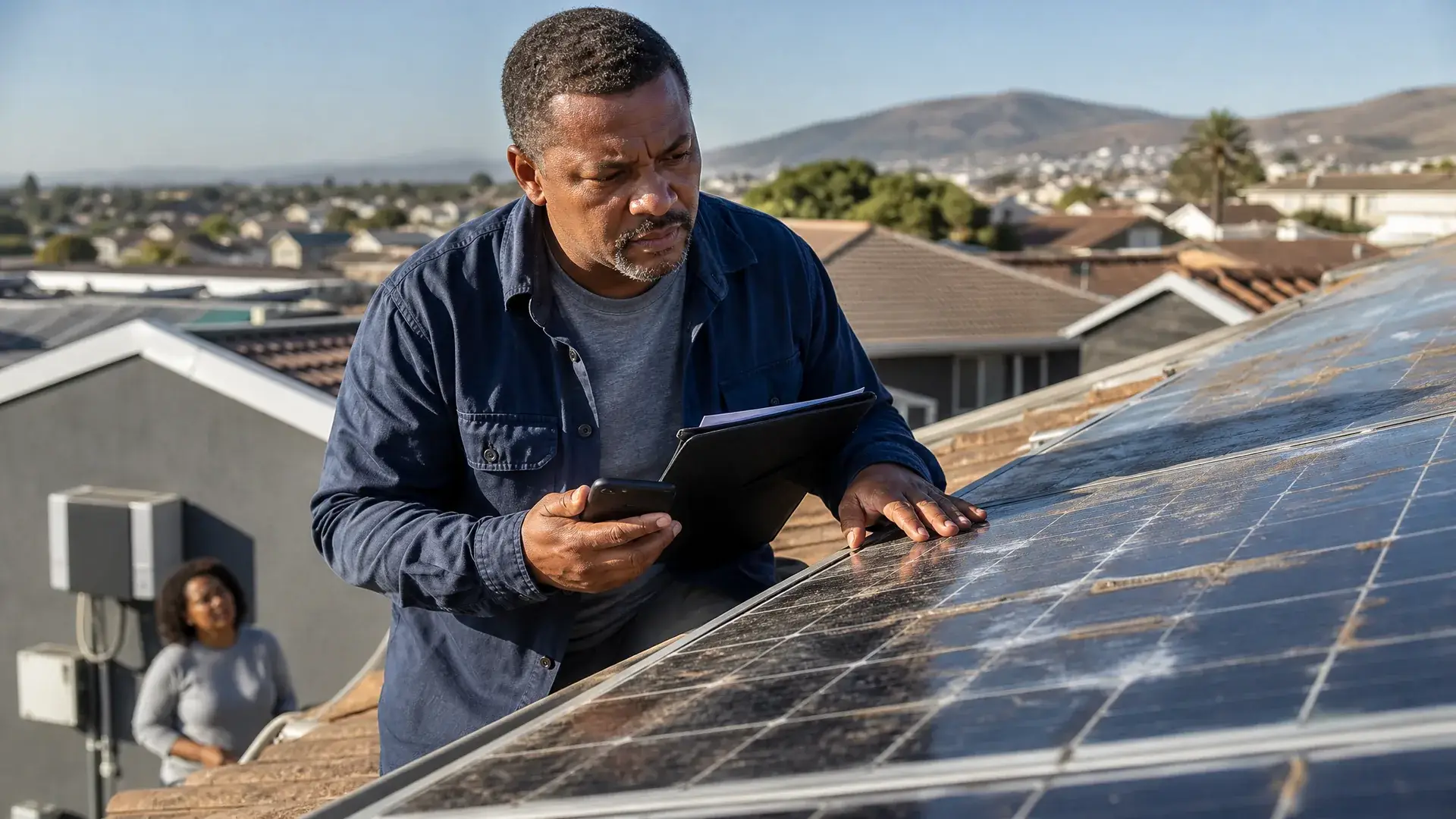
Solar panel warranty claims in South Africa are more complicated than most homeowners expect, and that gap between expectation and reality costs people time and money. Warranties come from different parties, cover different failure types, and expire on different schedules. This guide cuts through the confusion: what your warranties actually cover, how long they last, who to contact when something goes wrong, and how to lodge a claim that gets resolved.
What Solar Panel Warranties Actually Cover
Before you can make a claim, you need to know which warranty applies to your problem. There are two distinct types, and mixing them up is the most common reason claims stall.
Equipment Warranty Coverage Explained
Equipment warranty coverage applies to the physical hardware in your system, solar panels, inverters, and batteries. It protects against manufacturing defects, premature failure, and material or workmanship faults in the product itself.
For solar panels, there are two separate equipment promises:
- Product warranty, covers physical defects, delamination, cracked cells, corrosion, or failure of the panel as a manufactured item.
- Performance warranty, guarantees the panel will still produce a minimum percentage of its rated output over time. Most tier-one manufacturers, including LONGi, JA Solar, and Canadian Solar, offer a linear performance guarantee extending to 25–30 years, with the panel required to produce at least 80–87% of rated output at end of term.
What equipment warranties do not cover: damage caused by storms, lightning, flooding, theft, or improper installation. Those are either insurance events or installer responsibility.
Installation Warranty: What Your Installer Is Responsible For
The installation warranty, sometimes called a workmanship warranty, sits separately from any product warranty. Your installer is responsible for the quality of their labour: cable routing, mounting, electrical connections, inverter configuration, and compliance with South African electrical standards.
If panels are mounted incorrectly and water ingress damages them, that is an installation warranty issue. If an inverter is wired with incorrect polarity and fails early, that is also the installer’s responsibility, not the manufacturer’s.
South Africa’s Consumer Protection Act (CPA) 68 of 2008 provides a baseline here. Under Section 56, consumers have an implied warranty against defects for six months after installation, even if the installer’s written workmanship warranty is shorter. So if a fault shows up in the first six months, your statutory rights apply regardless of what the contract says.
Solar Panel Warranty Length: What to Expect in 2026
Understanding solar panel warranty length helps you benchmark whether what you are being offered is standard or substandard.
Solar panels carry two warranty periods running in parallel:
- Product warranty: typically 10–12 years for tier-one brands
- Performance warranty: 25–30 years, with annual degradation allowances defined in the warranty document
Inverters carry shorter standard warranties because they contain more active electronic components. Most brands active in the South African market, including Fronius, SolarEdge, and Sungrow, offer standard warranties of 5–10 years, with the option to purchase extended cover up to 20 years. If a quoted inverter warranty is shorter than five years, that is worth questioning.
Battery storage warranties are typically rated by both years and cycle count, whichever comes first. Common terms run 10 years or a set number of charge cycles, with a guaranteed capacity retention threshold (often 60–70% of original capacity at end of warranty). For more detail on battery storage warranty options, the specifics vary by chemistry and brand.
Workmanship warranties from installers vary more than product warranties. Reputable installers offer two to five years on labour and installation quality. Anything under two years deserves scrutiny.
Given what solar panels cost in South Africa, a 25-year performance commitment is a significant financial promise. Make sure it is in writing and from a brand with local distributor support.
Manufacturer vs Installer: Who Is Responsible for Your Claim?
This is where most South African solar owners lose time. They contact the wrong party first, get redirected, and spend weeks without resolution. Getting this right at the start cuts that delay significantly.
When to Go to the Manufacturer
Contact the manufacturer, or their local South African distributor, when the problem is with the product itself:
- A panel has visibly delaminated, cracked, or corroded under normal conditions
- An inverter has failed before its warranty expiry with no external cause
- A battery is not holding charge after fewer cycles than the warranty allows
- Measured output has fallen below the performance warranty threshold
You will need your purchase documentation, the serial number of the failed component, and ideally a system performance report showing the degradation. The claim goes to the distributor who sold the product into South Africa, not always to the overseas manufacturer directly.
When to Go Back to Your Installer
Contact your installer when the failure traces back to how the system was installed:
- Cables have burned or corroded due to poor termination
- A mounting system has failed or shifted due to inadequate fixing
- Water has entered a junction box that was not properly sealed
- The system underperforms because of shading or orientation errors made at design stage
Consider a real-world scenario on the Garden Route: a homeowner notices reduced output two years after installation. If the inverter is faulty, the claim goes to the inverter manufacturer or their local distributor. If the wiring was done incorrectly, the responsibility sits with the installing contractor. Confusing the two means both parties can point fingers while nothing gets fixed.
For systems with multiple components and scopes, such as hybrid solar system components including panels, batteries, and a grid-tied inverter, you may need to manage more than one claim simultaneously. Document each component’s issue separately.
How to Make a Solar Panel Warranty Claim in South Africa
Step-by-Step Claim Process South Africa
Following a clear claim process in South Africa protects your rights and speeds resolution. Here is the practical sequence:
-
Identify the failure type. Is it a product defect, a performance shortfall, or an installation fault? This determines who you contact.
-
Gather your documentation before making contact:
- Original invoice and installation contract
- Warranty schedule or certificate (product, performance, and workmanship)
- System commissioning report or handover checklist
- Any monitoring data showing the performance issue (screenshots from your app or inverter portal work)
- Photos of visible damage or faults
-
Contact the responsible party in writing. Email creates a paper trail. State the fault clearly, reference the warranty terms, and include your serial numbers and installation date.
-
Allow a reasonable response window. Most reputable manufacturers and installers respond within 5–10 business days for initial acknowledgement. If you receive no response, follow up in writing and reference your CPA rights.
-
Request a site visit or inspection. Most claims require physical inspection before a remedy is offered. Do not allow repair work to begin before the cause of failure is agreed in writing.
-
If a claim is disputed, escalate in writing to the distributor’s regional office or, for installer disputes, to the National Consumer Commission under the CPA. Keep every piece of communication.
Maintaining records of routine solar panel maintenance is also part of your claims defence, documented servicing shows the system was properly cared for.
Common Reasons Warranty Claims Are Rejected
Knowing why claims fail lets you protect your cover from day one.
Improper installation is the leading rejection ground for product warranty claims. Manufacturers will investigate whether installation met their specifications. If a panel was mounted at the wrong angle, stored incorrectly before installation, or wired outside the manufacturer’s stated parameters, the product warranty may be void, even if the panel itself is defective.
No maintenance records. Many warranties require the system to be reasonably maintained. A complete absence of cleaning or inspection records can be used to argue that neglect contributed to the failure.
Physical or impact damage. Cracks, chips, or burn marks from external events, hail, falling branches, lightning strike, are not covered under product or performance warranties. They are insurance claims. Trying to claim these under warranty will be rejected.
Unauthorised modifications. Adding components, changing inverter settings beyond approved parameters, or connecting unapproved batteries can void warranties across the entire system. Always check with your installer before making any changes.
Missing documentation. If you cannot produce the original invoice, serial number, or warranty certificate, the claim process stalls. Keep digital copies stored off-site.
Warranty transferred incorrectly. If you bought a property with an existing solar system, confirm in writing that warranties were transferred to you. Many product warranties are transferable, but the transfer must be formally registered with the manufacturer or distributor.
For commercial solar installation warranty considerations, the documentation requirements and liability structures are more complex. Businesses should confirm warranty assignability before system handover.
Protecting Your Long-Term Solar Investment on the Garden Route
A solar system is a 25-year commitment. The quality of your warranties, and your ability to enforce them, depends heavily on who installs the system and what paperwork they hand over on day one.
Everlife Group recommends that every client receive a written warranty schedule at handover: a single document listing the product warranty, performance warranty, and workmanship warranty terms, with clear contact details for each responsible party. That document is your first line of defence for any future solar panel warranty claims in South Africa.
On the Garden Route specifically, coastal conditions, humidity, salt air, and temperature variation, place real stress on system components. Choosing an installer with a local presence means warranty support does not disappear if the original sales contact moves on.
When evaluating any installer, ask directly: what is your workmanship warranty period, and who do I contact if I have a product claim in year seven? A confident, specific answer signals a company that stands behind its work. If the answer is vague, that is useful information too.
Everlife Group is available to review your existing warranty documentation or walk you through what to expect before you commit to an installation. Reach out before you sign, it is far easier to clarify warranty terms upfront than to chase them down after something goes wrong.