
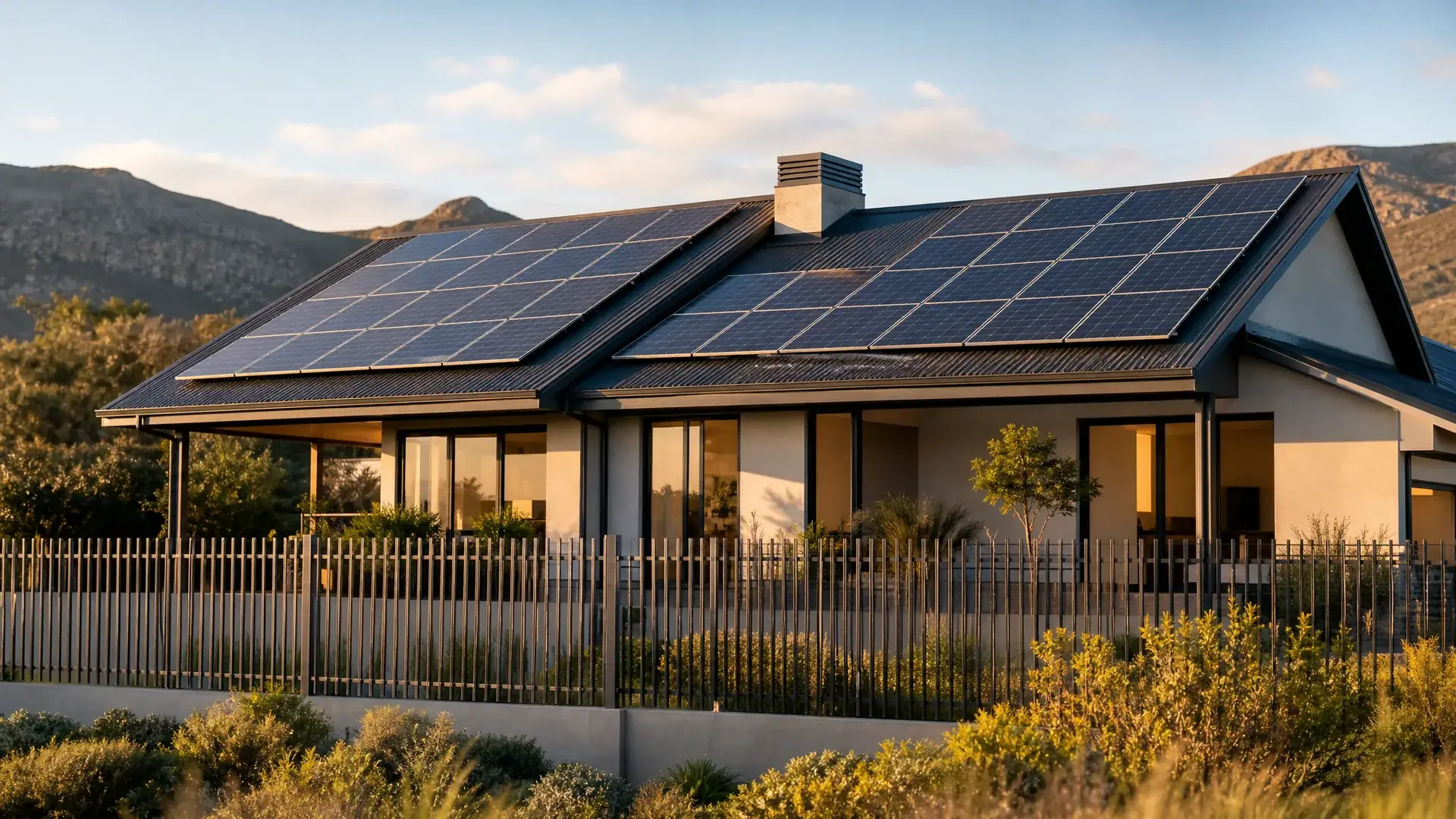
Adding solar panels to a home raises an immediate question for any property owner: does it actually translate into a higher selling price? In international markets, the answer is increasingly clear. For solar energy property value in South Africa, the picture is more nuanced, but the signals from buyers, agents, and valuers all point in one direction. Energy independence has become a visible, marketable asset, and sellers who can prove it are gaining an edge.
What the Global Research Says About Solar Energy and Home Value
Key Findings from International Studies
Research from the Lawrence Berkeley National Laboratory in the United States consistently found that homes with solar installations sold for a measurable premium over comparable non-solar homes. The exact uplift varied by market maturity and system size, but the finding is a benchmark in international real estate and energy literature. Zillow has similarly reported that solar-equipped listings attracted stronger buyer interest and faster sale timelines in mature US markets.
European studies from markets such as the Netherlands and Germany show comparable trends. Buyers there have shown willingness to pay more for homes with documented, grid-tied solar systems, particularly where electricity tariffs are high and energy costs are a real household concern.
Why Global Data Doesn’t Translate Directly to South Africa
The US and European findings are useful as a directional reference, but they don’t map neatly onto the South African context.
In those markets, solar is primarily a cost-saving feature. Buyers calculate the avoided electricity bill and price accordingly. South Africa introduces two factors those markets simply don’t have: chronic grid unreliability and one of the fastest-rising electricity tariff trajectories in the world.
Load-shedding, and the broader uncertainty about Eskom’s long-term stability, means South African buyers aren’t just paying for savings. They’re paying for certainty. That shifts the psychology of the purchase, and it shifts the premium solar commands. The question isn’t only “how much does this cut my bill?” It’s “will I have power when I need it?”
Solar Energy Property Value in South Africa: The Local Picture
What SA Buyers and Agents Are Saying
Formal, peer-reviewed research on solar’s effect on residential resale prices in South Africa remains limited. No widely published local equivalent of the Lawrence Berkeley studies exists yet. This is a genuine gap for sellers trying to quantify the uplift, but the absence of hard data doesn’t mean the premium isn’t real.
Lightstone Property and FNB’s periodic residential property reports have noted that energy resilience features, including solar and battery backup, increasingly appear in buyer requirement surveys, particularly among repeat buyers in the R2 million-plus segment. These buyers are not asking whether a home has solar; they’re often filtering out homes that don’t.
Estate agents operating in lifestyle and high-demand corridors have adapted their listing language accordingly. “Fully off-grid,” “load-shedding proof,” and “energy independent” have become headline descriptors rather than footnotes. Solar has moved from a nice-to-have to a selling point that drives enquiry volume.
The Load-Shedding Premium
Through 2024 and into 2026, a distinct buyer perception premium emerged around what the market informally calls “grid independence.” Homes that could demonstrate genuine energy security, meaning uninterrupted power through a hybrid solar-plus-battery setup, commanded stronger interest at listing and shorter days-on-market in active corridors.
This premium is harder to appraise formally than, say, an extra bedroom. But it is real, and it is growing. As Eskom tariffs continue to rise and grid reliability remains uncertain heading into 2027, the gap between solar-equipped and non-solar homes is unlikely to narrow.
How Solar Panels Affect a Home Appraisal in South Africa
Owned System vs Financed System: What Appraisers Consider
South African bank valuers and appraisers do factor solar installations into residential valuations, but the approach is not yet standardised across all institutions or valuation firms. Several variables influence how much weight an installation receives.
System ownership is the most consequential factor. A solar system owned outright by the homeowner is a fixed improvement to the property, it transfers with the sale and adds clear asset value. A system installed under a Power Purchase Agreement (PPA) or rental arrangement is a different matter. Property valuers and conveyancers have flagged that such systems do not automatically transfer with the property, meaning sellers need to resolve the financing structure before listing. Buyers may be unwilling to take on a third-party agreement, or lenders may decline to include the system’s value in their assessment. Outright-owned systems avoid this complication entirely.
Beyond ownership, appraisers consider system age, equipment brand, rated output, and whether documented maintenance records exist. A well-branded, right-sized system with warranties intact and a clean service history carries meaningfully more weight than an undocumented installation of unknown origin. Keeping your solar system maintained and documented is directly relevant to your appraisal outcome.
The lack of a standardised SA appraisal framework for solar means sellers who can present comprehensive documentation, output data, warranty certificates, installation compliance certificates, are effectively compensating for the gap themselves, giving valuers the evidence they need to justify a higher figure.
Regional Variation: Does Location Affect the Solar Resale Premium?
South Africa’s property market is not uniform, and neither is the solar premium across regions.
Premium lifestyle corridors, the Cape Town Atlantic Seaboard, the Garden Route, and Sandton, show the strongest signals. Buyers in these markets are typically higher-income, often purchasing second or lifestyle properties, and they price convenience and security into their decisions. In these corridors, estate agents began openly marketing “fully off-grid” and “load-shedding-proof” as headline features from 2023 onward, reflecting buyer demand that has moved well beyond cost-saving.
The Garden Route has become a high-visibility market for energy-independent properties. As a lifestyle-driven region where buyers are often relocating permanently or semi-permanently, uninterrupted energy supply is a functional requirement. A home on the Garden Route that can demonstrate genuine grid independence isn’t competing on solar alone, it’s competing on quality of life.
In rural and township markets, the dynamic is different. Affordability constraints and the absence of a formal solar appraisal premium make the resale uplift from solar less predictable. Grid connectivity is also less uniform, which complicates comparisons. At this stage, the resale premium for solar is most reliably captured in the mid-to-upper market segments and urban lifestyle corridors.
Maximising Your Property Resale Value With Solar
System Quality, Sizing, and Documentation
Not all solar installations contribute equally to resale value. A system that is undersized for the home’s consumption profile, uses off-brand components with no local warranty support, or lacks documentation is difficult for an appraiser to value confidently, and may raise concerns for a cautious buyer.
The systems that transfer well share common characteristics: correctly sized for the property, reputable panels and inverters, manufacturer warranties, and maintenance records. Understanding what solar panels cost in South Africa helps homeowners calibrate investment against realistic resale uplift and avoid under- or over-specifying their system.
Compliance certification, a Certificate of Compliance (CoC) issued by a registered electrician, is also essential. Without it, the installation is not legally recognised, which creates risk at transfer.
Pairing Solar With Battery Storage
By 2026, a solar-only installation is increasingly seen as an incomplete solution in the South African market. Buyers who understand the landscape know that panels alone don’t provide power during grid outages, battery storage is what delivers true energy independence.
Hybrid solar systems that combine panels, battery storage, and grid connection are the benchmark buyers in premium markets now expect. A solar-only system may reduce electricity costs, but a hybrid setup addresses the load-shedding question directly. That’s the premium buyers are actually paying for.
The best battery storage options available in South Africa are a practical consideration for any homeowner planning to install or upgrade with resale value in mind. Lithium-ion battery systems from established brands, with local warranty support and verifiable capacity specs, are the ones appraisers and buyers can assess with confidence.
Is Solar Worth It as a Property Investment in South Africa?
The investment case for solar in South Africa now rests on two pillars, not one.
The first is the ownership period: meaningful reductions in monthly electricity costs, compounding as Eskom tariffs continue to rise. South Africa’s electricity price trajectory has been upward for over a decade, and no credible forecast changes that direction heading into 2027. Every unit of solar energy consumed in the home is a unit not purchased from a grid that costs more each year.
The second is resale uplift. Formal SA-specific data on the exact rand-value premium remains sparse, but the qualitative signals, buyer surveys, listing language, agent commentary, and valuer practice, all point to solar as a genuine value driver in the mid-to-upper market. The dual ROI argument is real, and it strengthens each year the grid remains unreliable.
Sellers who invest in a well-specified, owned, documented hybrid solar system are better positioned on both counts: lower running costs during ownership, and a stronger hand at transfer.
For homeowners in the Garden Route, Everlife Group offers solar assessments tailored to your property’s consumption profile and your goals, whether you’re planning to stay for years or preparing to sell. A consultation is the clearest first step toward both energy independence and a stronger resale position. Reach out to Everlife Group to get started.