
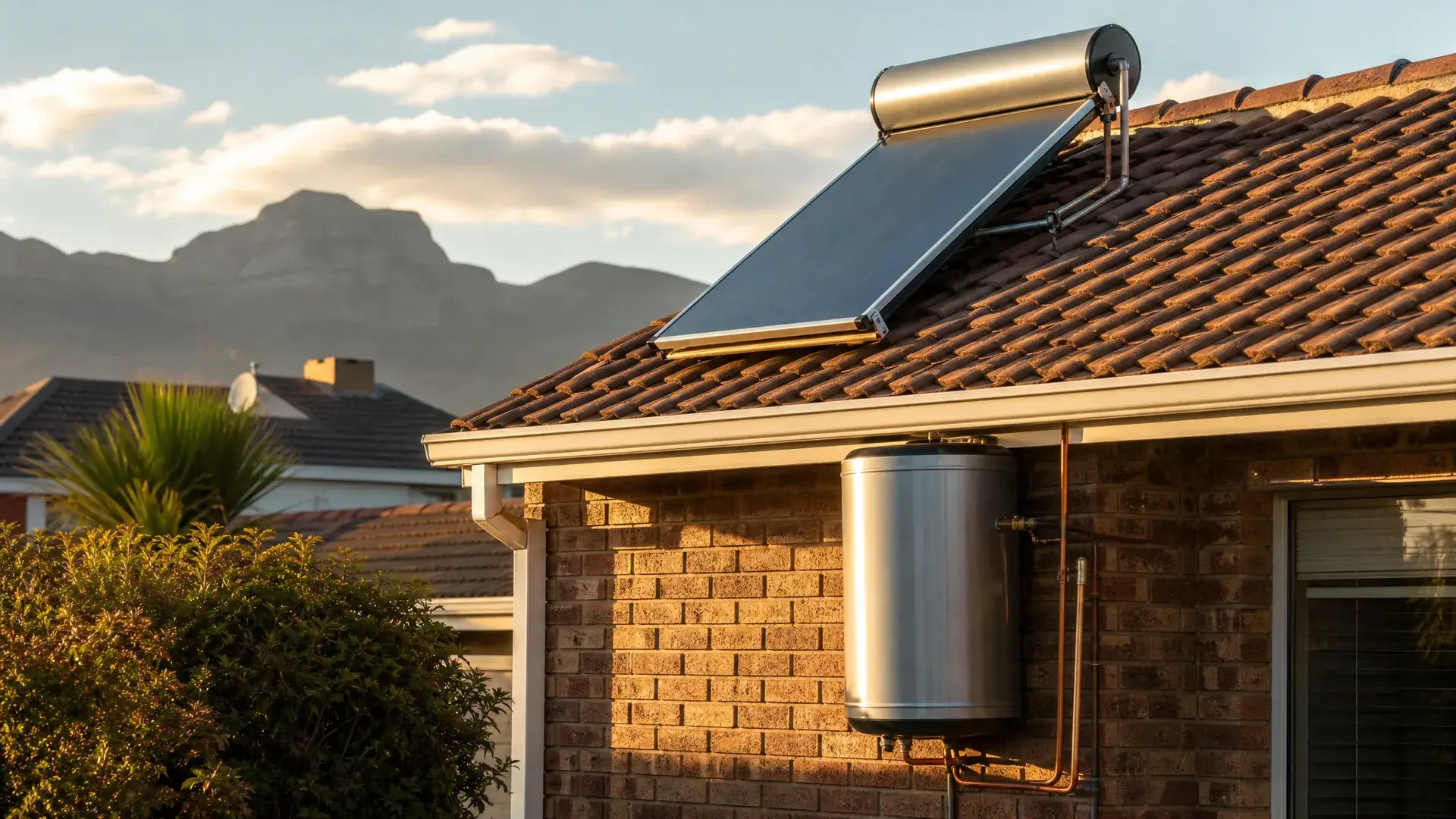
Water heating is one of the heaviest electricity loads in any South African home, accounting for roughly 30–40% of total household electricity consumption. That single fact makes the solar hot water system cost SA calculation worth doing carefully. With Eskom tariffs continuing their climb into 2026, the payback numbers are getting more compelling every year. This guide breaks down real cost ranges, regional performance differences, and honest payback timelines so you can budget with confidence.
What Does a Solar Hot Water System Cost in South Africa?
Supply-only prices for a residential solar water heating system start at around R8,000–R12,000 for a basic 150-litre flat-plate system. Mid-range 200-litre systems, the most common household size, typically run R14,000–R22,000 fully installed. Premium evacuated-tube systems for larger households (300 litres) sit in the R25,000–R40,000 installed range, depending on brand, roof complexity, and location.
These ranges reflect 2026 market pricing. SANS 10400-XA, South Africa’s energy-efficiency building standard, requires solar water heaters in new residential builds. That mandate has normalised installer supply chains and increased product availability, keeping installed costs more competitive in 2026 than they were five years ago.
Flat-Plate vs. Evacuated-Tube Collectors: Price Differences
Flat-plate collectors are the more affordable option and perform well in consistently sunny regions. Evacuated-tube collectors cost more upfront, typically 20–35% more for an equivalent tank size, but their insulated glass tubes trap heat more efficiently under overcast skies or in cooler ambient temperatures.
For most of the Northern Cape, Free State, and inland Karoo, a flat-plate system is a solid choice. Along the Garden Route and Western Cape coast, where winter cloud cover is a real factor, the extra investment in evacuated tubes often pays back through reduced reliance on the electrical back-up element.
Installation Cost Factors That Affect Your Final Quote
Several variables move the final price beyond the collector and tank:
- Roof type, tiled roofs require different mounting brackets than IBR or Chromadek sheeting; some configurations need structural reinforcement.
- Geyser size, a 150-litre system suits 1–2 people; 200 litres covers 3–4 people; 300 litres is appropriate for larger households or high-demand properties.
- Labour rates by region, installation labour in the Garden Route towns of George, Knysna, and Plettenberg Bay is broadly comparable to Cape Town metro rates, but travel to outlying properties adds cost.
- Height and access, two-storey homes or steeply pitched roofs increase installation time and safety requirements.
Solar Geyser Installation Cost: What’s Included and What Isn’t
A properly quoted installed price should cover: the solar collector, the geyser/storage tank, mounting hardware, a differential controller (which manages when the pump runs), and all plumbing labour. That’s the baseline.
What often catches buyers off guard:
- Electrical back-up element, most systems include a 3kW or 4kW element for cloudy days, but wiring it into your DB board is sometimes quoted separately.
- SANS 10400-XA compliance certification, required for new builds and increasingly expected by insurers on retrofits; factor in any additional certification fees.
- Municipal or body corporate approvals, some coastal municipalities and estates require submission of plans before installation; this adds time and occasionally a fee.
- Frost protection, properties above 1,000m or in frost-prone inland areas need glycol antifreeze in the collector loop, which adds to the initial fill cost and requires periodic top-up.
Getting a line-item quote, not just a single total, is the best way to avoid surprise costs after the job is done.
Climate-Adjusted Performance Across SA Regions
South Africa is, on average, one of the best solar resource countries in the world. But “on average” hides meaningful regional variation that directly affects how much of your hot water demand a solar system can cover.
The Northern Cape and Karoo enjoy high solar irradiation year-round with minimal cloud cover. A 200-litre system in those regions can meet 70–80% of a household’s annual hot water demand from solar alone. Move to the Garden Route or the Western Cape coast, and that figure drops to closer to 55–65% because of winter overcast periods and coastal fog. Still excellent by global standards, but the difference matters for sizing and back-up budgeting.
How the Garden Route’s Climate Affects Solar Water Heater Output
The Garden Route’s coastal microclimate is characterised by south-westerly fronts in winter (June–August), frequent morning fog around Knysna and Plettenberg Bay, and mild but often overcast conditions. Compared to Upington or Beaufort West, a collector on the Garden Route sees meaningfully fewer peak sun hours during winter months.
Everlife Group installs and services solar water heating systems across the Garden Route, with direct field experience in how these coastal microclimates affect system sizing and back-up element requirements in George, Knysna, and Plettenberg Bay. Knowing when to specify evacuated tubes, when to upsize the tank, and how to position collectors for maximum winter gain is what separates a correctly sized system from one that underperforms.
Seasonal Performance: Winter Shortfalls and Back-Up Heating Costs
Even in the Garden Route, summer performance is strong. The problem is the June–August window, when the electrical back-up element carries more load. For a typical 200-litre system in a coastal location, expect the back-up element to contribute 30–40% of heating energy during those three months, compared to 15–25% over the rest of the year.
Budget for slightly higher winter electricity consumption from your geyser than national marketing figures suggest. An honest system quote accounts for this by sizing the tank and collector correctly for the specific location.
Payback Period Calculations: Energy Saving Water Heating in Practice
South Africa’s electricity tariffs have roughly doubled over the past decade, and Eskom’s approved increases continue through 2026 and into 2027. That trajectory is the single biggest driver shortening payback periods for solar water heating.
How to Estimate Your Household Savings
A straightforward payback model works like this:
- Estimate your current geyser electricity spend. A family of four using a 200-litre electric geyser typically consumes 150–200 kWh per month on water heating alone. At current blended Eskom tariff levels (above R2.50/kWh for most urban consumers in 2026), that’s roughly R375–R500/month, or R4,500–R6,000/year.
- Apply your solar contribution factor. Inland high-irradiance households can offset 70–80% of that demand; Garden Route coastal households offset 55–65%.
- Annual saving range: An inland household saves approximately R3,150–R4,800/year. A Garden Route household saves approximately R2,475–R3,900/year.
- Divide system cost by annual saving to get payback years.
Payback Timeline: Typical Scenarios
| Scenario | Installed system cost | Annual saving | Payback period |
|---|---|---|---|
| Inland high-irradiance (e.g. Karoo), 200L flat-plate | R18,000 | R4,000 | ~4.5 years |
| Garden Route coastal, 200L evacuated-tube | R22,000 | R3,200 | ~6.9 years |
Both scenarios comfortably precede the typical 15–20 year lifespan of a quality solar water heater. Load-shedding also plays a role: households without backup power find that solar water heating maintains hot water availability during outages because the tank retains heat for 12–24 hours, reducing the temptation to run a gas or diesel alternative.
Hot Water Solar Panels Cost vs. Long-Term Value
The real case for solar water heating isn’t the payback period, it’s what happens after it. A well-maintained system installed in 2026 will still be generating essentially free hot water in 2036 and likely beyond. Over 15 years, the cumulative electricity saving at rising tariff rates substantially exceeds the initial investment, even for coastal systems with moderate solar contributions.
Compare that to a conventional electric geyser: the geyser itself costs R3,000–R6,000 and has a lifespan of 8–12 years, but the ongoing electricity cost compounds with every tariff increase. The total cost of ownership over 15 years heavily favours solar.
Maintenance costs are real but modest:
- Anode rod replacement every 3–5 years in high-mineral-content water areas (R500–R1,500 including labour)
- Glycol top-up for frost-prone properties, typically every 3–5 years
- Annual visual inspection of collector glazing, mountings, and controller settings, budget R500–R800/year for a service contract
Choosing the Right Solar Water Heating System for Your Property
Start with household size to determine tank capacity:
- 150 litres, 1 to 2 people
- 200 litres, 3 to 4 people (the most common residential choice)
- 300 litres, 5+ people or high-demand properties
Then check roof orientation. A north-facing roof at a pitch of 20–45° is optimal in South Africa. East- or west-facing installations are workable with modest output reduction; south-facing is generally not viable without a mounting frame to compensate.
If you already have rooftop PV, solar water heating is a smart complement rather than a competitor. Water heating absorbs a large share of household electricity demand, addressing it with a dedicated thermal system frees your PV panels and battery capacity for other loads. For a fuller picture of solar panel system costs in South Africa, or if you’re exploring combining solar water heating with a hybrid solar system, both work together to reduce grid dependence. You can also review battery storage options for full energy independence to understand how storage fits the broader picture.
Solar hot water system cost in SA is a one-time investment with a clear, calculable return, and that return is faster in 2026 than it’s ever been.
Ready to get a climate-aware quote for your property? Everlife Group sizes and installs solar water heating systems across the Garden Route, accounting for local microclimate conditions in George, Knysna, Plettenberg Bay, and surrounding areas. Contact us for a site-specific assessment and see exactly what your system will cost and save.
One Comment
[…] not just an appliance. For broader context on how local pricing compares to national averages, national solar hot water cost benchmarks are worth reviewing before you request […]