
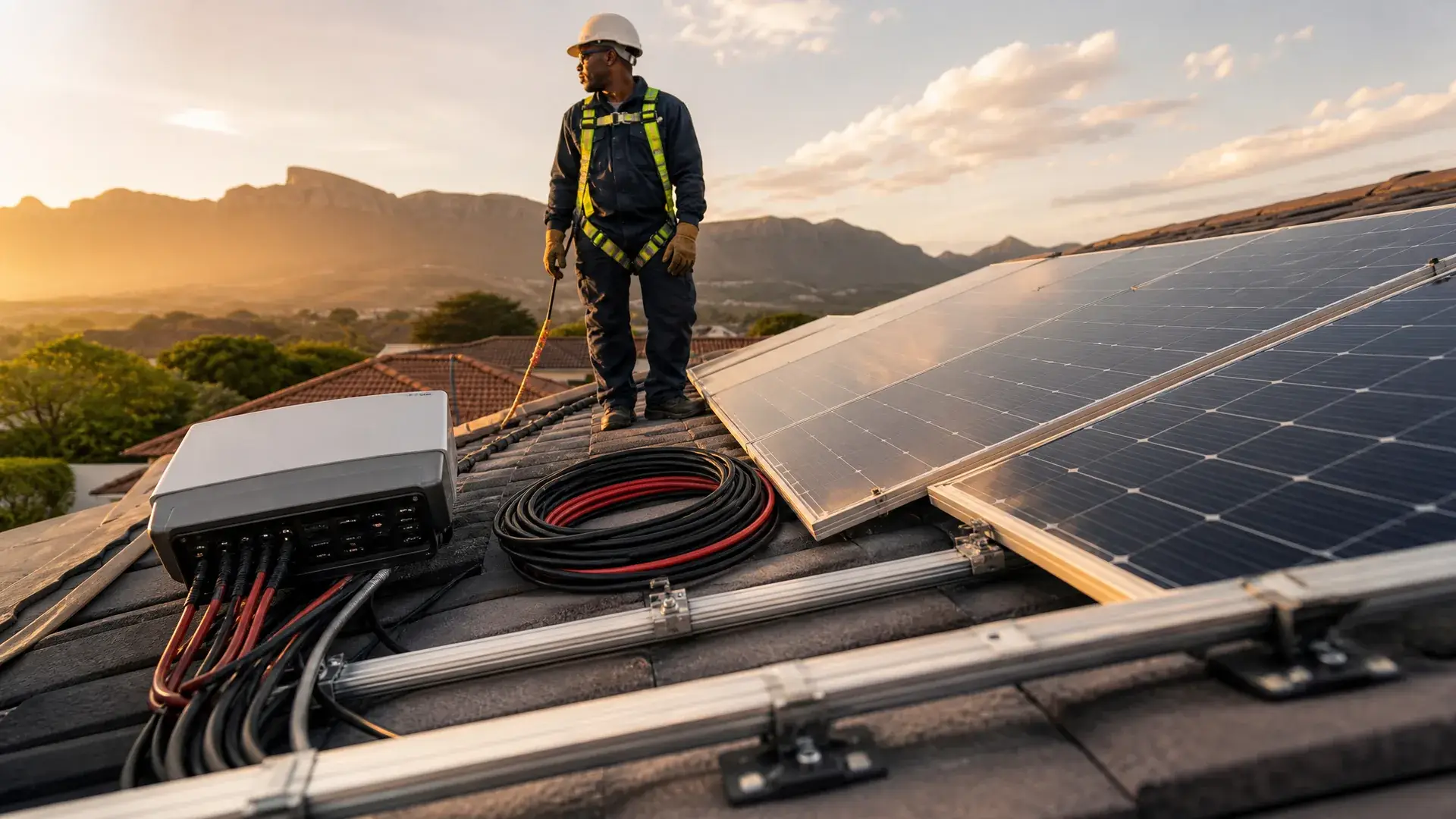
Most homeowners researching the cost to install solar panels South Africa 2026 start with the wrong number. They find a panel price, assume that’s the whole job, then get a quote that’s noticeably higher and wonder what happened. The gap isn’t a hidden markup. It’s everything that turns a stack of panels into a working, compliant power system. This guide separates panel-only pricing from true installed cost, and breaks down labour, permits, regional differences, and the extras that catch people off guard.
Installed Cost vs Panel Price: What 2026 Solar Quotes Really Include
A “solar panel price” usually refers to the hardware alone, the panels themselves, sometimes bundled with an inverter and battery. An “installed cost” covers labour, wiring, mounting, safety compliance, certification, and often a structural check of the roof. These two figures get conflated constantly in online searches, which is why so many people feel blindsided when a real quote arrives.
How much does it cost to install solar panels, separate from buying them?
Installation costs are typically a percentage of the total project rather than a flat add-on, and that percentage shifts with system size and site complexity. A small grid-tied system on an easy, accessible roof will have a smaller installation slice than a larger hybrid system with battery storage on a steep or hard-to-reach roof. If you haven’t yet settled on system size, it’s worth taking a step back to work out what size system you actually need before comparing installation quotes, since labour cost scales with capacity and complexity, not just with the price tag on the panels. For a sense of what the hardware itself typically costs before labour is added, the full solar panel cost ranges in South Africa are worth reviewing alongside this breakdown.
Solar Installation Labour Cost in South Africa: What Installers Charge
Solar installation labour cost in South Africa is generally priced one of two ways: as a rate per watt of installed capacity, or as a flat project fee scoped to the specific job. Both approaches are common. Neither is inherently better, what matters is that the quote clearly states what’s included.
Solar installation cost per watt explained
The solar installation cost per watt South Africa figure has moved over the past few years. Panel prices themselves have fallen steadily as global manufacturing has scaled up, but labour, electrical compliance work, and logistics have become a larger share of the total installed price. In practical terms, the “cost per watt” a homeowner sees quoted today reflects proportionally more skilled labour and certification work than it did when panels were the dominant cost driver. That’s a good reason to ask any installer to itemise labour separately from hardware, rather than accept a single bundled per-watt figure.
Factors that push labour costs up or down
Several things move a labour quote up or down:
- Roof type and pitch, tiled roofs, steep pitches, or unusual roof shapes take longer to work on safely than a straightforward corrugated iron roof.
- System size, more panels and more strings generally means more mounting, wiring, and testing hours.
- Site access, a single-storey home with easy roof access costs less to work on than a multi-storey property needing scaffolding or rope access.
- Inverter and battery complexity, a simple grid-tied inverter setup is quicker to wire and commission than a hybrid system with battery integration. That’s one reason choosing the right inverter type early in the process helps you get a more accurate labour estimate. If you’re weighing whether to add storage, it’s also worth understanding how hybrid solar systems with battery backup change both the electrical work involved and the total installed price.
- Existing electrical condition, an older or non-compliant distribution board adds hours before installation can even begin.
Permits, Certificates of Compliance, and Other Regulatory Fees
Labour is one line item. Regulatory sign-off is another, and it’s frequently left out of ballpark quotes found online.
Solar installation permit cost south africa: what’s actually required
A compliant residential solar installation in South Africa generally requires a Certificate of Compliance (CoC) from a qualified electrician, confirming the electrical work meets safety standards. Depending on the system and municipality, there may also be a grid-tie application or notification process with the local electricity provider, particularly for systems that feed excess power back into the grid. Solar installation permit cost South Africa figures vary by municipality and system type, so it’s not a single national number. It is a real, separate cost that should appear as its own line on any legitimate quote, not be folded silently into “installation.”
Skipping this step to save money is a false economy. Without a CoC, insurance claims related to electrical faults can be denied, and municipal approval for grid feed-in generally requires it anyway.
Garden Route Solar Installation Pricing: Regional Differences That Matter
National averages are a starting point, not a quote. Solar panel installation fees Garden Route homeowners see often differ meaningfully from what’s quoted in Johannesburg, Pretoria, or Cape Town’s inner suburbs.
Why solar panel installation fees garden route can differ from major metros
Three factors tend to drive this:
- Travel and logistics, installer teams covering towns spread along the coast, from Mossel Bay through George to Knysna and Plettenberg Bay, factor travel time into labour costs differently than a metro installer working within a dense service area.
- Roof types common to the region, Garden Route homes often feature tiled or thatch-adjacent roof styles suited to the climate, which can require different mounting approaches than the corrugated iron common in some inland metros.
- Coastal corrosion considerations, salt air along the coast accelerates corrosion of unprotected metal components, so installers in coastal towns often specify marine-grade fixings and mounting hardware. That costs more than standard-grade equivalents, but it protects the system’s lifespan.
Garden Route solar installation pricing also reflects local competition and the availability of qualified installers in smaller towns versus large metros, which can push quotes in either direction depending on the season and current demand. Everlife Group’s Garden Route install teams routinely quote total installed cost separately from panel-only pricing, so homeowners can compare apples to apples before committing to any single supplier. A typical 5kW residential system in George or Knysna often shows a noticeably different labour and logistics line item than the same system quoted in a metro area, largely due to travel time and roof access. That’s exactly why a region-specific quote matters more than a national average.
Hidden Costs Homeowners Overlook in a Residential Solar Installation Cost Breakdown
A residential solar installation cost breakdown that only lists panels, inverter, and “installation” is incomplete. Installers generally caution that the cheapest quote on paper often excludes certificate of compliance fees, structural roof assessments, or DB board upgrades, costs that surface later as unwelcome extras once work has already begun.
DB board upgrades, scaffolding, and other line items easy to miss
Common overlooked costs include:
- Distribution board (DB) upgrades, older boards often need upgrading to safely handle a new solar circuit, and this is rarely included in a base quote.
- Scaffolding or roof access equipment, multi-storey homes or steep roofs may require rented scaffolding, an added cost separate from labour hours.
- Roof repairs or reinforcement, if a structural assessment finds the roof needs work before panels can go on, that’s a separate contractor cost.
- Cabling runs and trunking, longer cable runs between roof and inverter, or inverter and DB board, add material and labour.
- Monitoring or metering equipment, smart meters or monitoring add-ons are sometimes quoted separately from the core system.
- Earthing and lightning protection upgrades, required in some installations to meet current safety standards.
The fix is straightforward: insist on a fully itemised written quote before signing anything, and ask directly whether CoC fees, DB work, and access equipment are included or excluded. It’s also worth asking whether any renewable energy tax incentives that offset installation costs apply to your situation, since these can meaningfully change the net cost once the full breakdown is on the table.
DIY vs Professional Solar Installation Cost, and How Financing Changes the Total
The DIY vs professional solar installation cost question comes up often, especially among homeowners comfortable with basic electrical or DIY work. The appeal is obvious: cutting out labour costs can look like a significant saving on paper.
When DIY installation cost savings aren’t worth the risk
In practice, the risk usually outweighs the saving. Grid-tied solar work in South Africa needs to be signed off with a Certificate of Compliance, and that generally requires a qualified, registered electrician regardless of who physically mounted the panels. A self-installed system without proper certification can also void manufacturer warranties on panels, inverters, and batteries. It’s worth understanding what your installation warranty should cover before assuming any DIY shortcuts are covered. There’s also a genuine safety dimension: rooftop electrical work carries real risk, and incorrect wiring or mounting can cause fire or shock hazards that a qualified installer is trained to avoid.
For most homeowners, the money “saved” on DIY labour is offset by the cost of getting a professional to inspect, correct, and certify the work afterward anyway. At that point, the DIY approach has cost more, not less.
How financing affects the total installed cost over time
Cash buyers pay the installed cost once, upfront, with nothing added afterward. Homeowners who finance their system through a solar loan or rent-to-own plan often see a different total cost of ownership than a cash buyer, once interest and fees are factored in over the loan term. That doesn’t make financing the wrong choice. Spreading the cost can make solar accessible sooner, and monthly repayments are often designed to sit below or near what the household was previously paying for grid electricity. But it does mean the “total installed cost” figure on a financed quote isn’t the true total cost of ownership. Ask any lender or installer offering finance to show the full repayment schedule, including interest, so you can compare it honestly against paying cash or against a shorter-term loan.
Businesses weighing similar decisions at a larger scale may also want to look at commercial solar installation ROI, since financing structures and payback periods differ considerably between residential and commercial systems.
Getting an accurate installed cost, not a national estimate, not a panel-only price, starts with a proper site assessment. Everlife Group offers free, no-obligation site assessments and quotes for Garden Route homeowners, itemising labour, permits, and every line item discussed above so you know exactly what you’re paying for before you commit.