
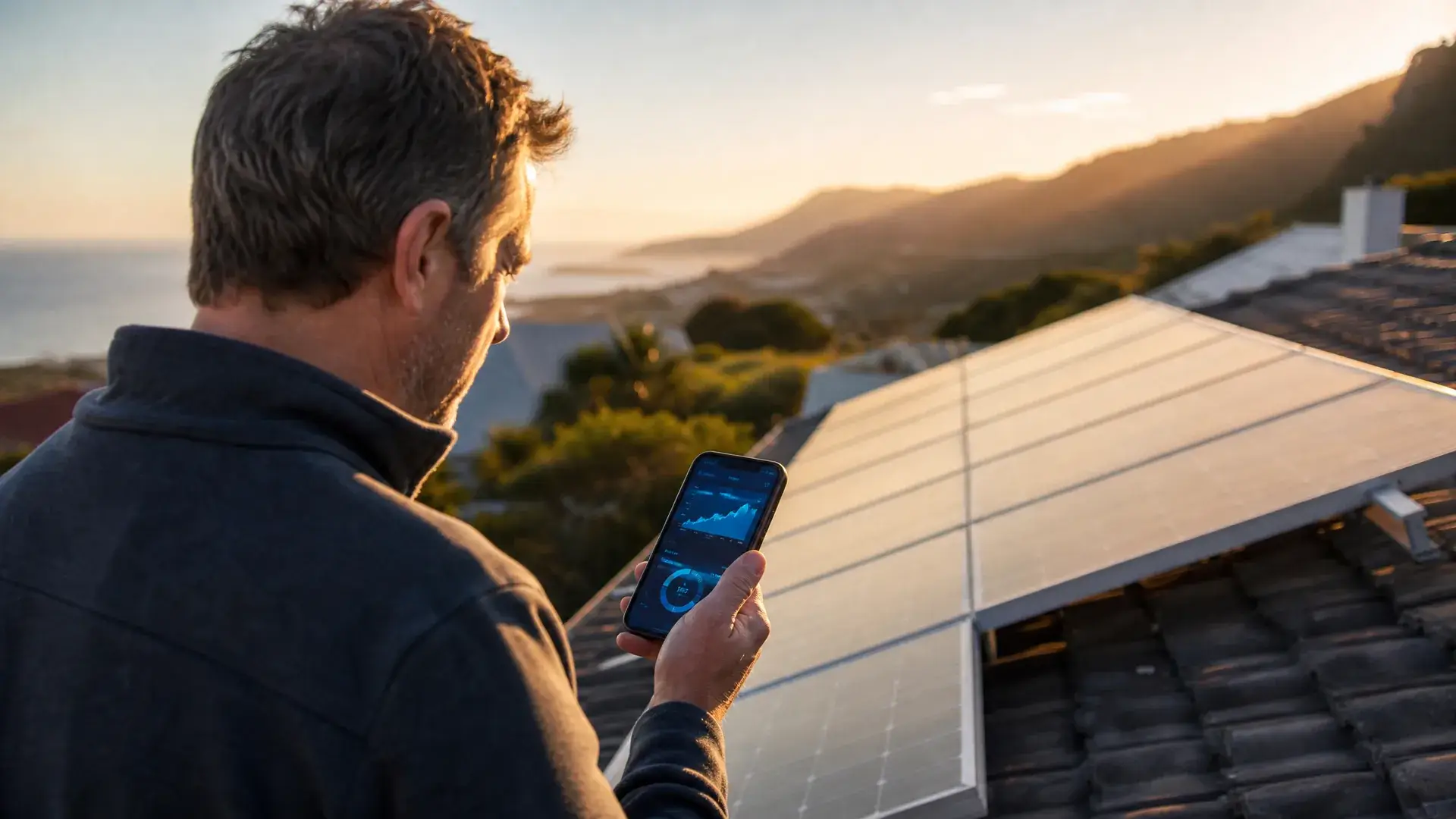
Solar panels generate power, but a monitoring system tells you what that power is actually doing. In South Africa, where grid outages and tariff changes complicate every energy decision, that visibility isn’t optional. If you’re comparing quotes or shortlisting installers along the Garden Route, understanding monitoring should shape your decision as much as panel brand or battery size does.
What a Solar Panel Monitoring System Is (and Why It Matters in South Africa)
A solar panel monitoring system tracks how much electricity your panels produce, how much your household uses, and how energy moves between your panels, battery, and the grid. It usually pairs a sensor or communication card in your inverter with an app or web dashboard. That’s the plain mechanics of it.
For homeowners anywhere, this data confirms the system works as promised. In South Africa, it does more. It becomes the record you rely on when the grid goes down, when Eskom tariffs shift, or when you need proof that a component underperformed.
How Monitoring Differs From Just Having Solar Panels
Panels without monitoring are a bit like a car without a dashboard. It still drives. But you have no way to see fuel levels, speed, or warning lights until something fails.
Monitoring adds that instrumentation. It shows real-time production, tracks performance over weeks and months, and flags problems before they cost you money. South African households often lean on solar during outages. That’s why ongoing feedback matters more here than in markets with stable grids.
How Loadshedding Stages Affect Your Solar Production Data
Loadshedding doesn’t just cut your grid supply. It changes how your whole system behaves, and a good monitoring dashboard shows that shift clearly.
South Africa has moved through more than a hundred days of loadshedding at various stages in recent years. That history has made real-time production and battery state-of-charge visibility a practical necessity for solar owners, not a feature buried in an app menu.
Reading Your Dashboard During a Loadshedding Event
When the grid drops, your dashboard should show the switch to battery or panel supply almost immediately. You’ll see production continue, consumption patterns adjust, and battery levels decline at whatever rate your household is drawing power.
A Garden Route homeowner tracking production against Eskom’s loadshedding schedule can see, within the app, exactly how many hours of grid outage their battery covered that week. That’s useful for judging whether your current battery capacity actually matches your loadshedding reality. If it doesn’t, you may need to rethink your setup, perhaps with a hybrid solar system with battery backup.
Tracking Eskom Tariff Spikes Against Your Export Data
Monitoring also helps you make smarter decisions about when to draw from the grid, when to run appliances off solar, and when to export excess power if your setup allows it.
Overlay your production and export data against Eskom’s tariff structure, and you can spot the hours when grid electricity costs most. Then you can shift usage, or battery discharge, to avoid those spikes. Over months, this kind of tracking turns into real savings. It’s a core part of solar ROI tracking in South Africa.
Key Metrics Every Solar System Dashboard Should Track
Not every monitoring dashboard is built the same way. Before you sign with an installer, it’s worth knowing which metrics genuinely matter for South African conditions.
Production, Consumption and Grid Export
At minimum, your dashboard should show real-time solar production, household consumption, and how much power moves to or from the grid. This production-versus-consumption tracking is the backbone of solar system performance tracking in SA.
Without it, you’re just guessing whether your system is sized correctly, or whether your usage habits work against your investment.
Battery State of Charge and Alerts
If your system includes storage, battery state-of-charge monitoring should be front and centre. You want to know, at a glance, how much stored energy you have before the next expected outage.
Good systems also send alerts tailored to South African conditions: inverter faults, panel underperformance, battery health warnings. These alerts catch a small problem early, rather than letting it turn into a bigger one you only discover on your next electricity bill. Pair that awareness with a routine ongoing solar panel maintenance checklist and you close most of the gap between “installed” and “reliable.”
Popular Solar Monitoring Platforms Available in SA
Most homeowners access their monitoring data through an app tied to their inverter brand. Several platforms are common across the South African market, each with its own strengths.
SolarEdge, Fronius Solar.web, GoodWe SEMS and SMA Sunny Portal Compared
SolarEdge monitoring in South Africa is known for detailed panel-level data. It lets you see the output of individual panels rather than just the system as a whole. That level of detail helps pinpoint issues like shading or a faulty panel quickly.
Fronius solar monitoring in SA, delivered through the Fronius Solar.web platform, offers a clean interface with strong historical reporting, useful for long-term performance tracking. GoodWe’s SEMS app is widely used with hybrid inverter setups and gives clear battery state-of-charge visuals. SMA’s Sunny Portal has a long track record and solid remote diagnostics.
All four typically offer mobile apps, so remote solar monitoring in South Africa is generally straightforward. You can check your dashboard from your phone, whether you’re at home, at work, or away for the weekend. The specific platform you get depends on your inverter, so it helps to understand the different solar inverter types available in SA before comparing installer quotes.
How Monitoring Protects Your Investment and Warranty Claims
Solar systems come with warranties, but warranties only work if you can show evidence something underperformed. This is where monitoring earns its keep long after installation day.
If a panel’s output drops below expected levels, or an inverter behaves erratically, your monitoring history gives you a documented record. Instead of a subjective complaint, you can hand an installer or manufacturer actual performance graphs.
Installers who prioritise transparent monitoring access tend to also honour warranty terms without friction. The data trail confirms system performance issues rather than relying on guesswork or memory. If you ever need to lodge a claim, knowing how to file a solar panel warranty claim in South Africa is far easier when you already have months of clean monitoring data behind you.
This same data turns solar ROI tracking in South Africa from a rough estimate into an actual number. You can compare projected savings against what your system delivered, month by month, and adjust expectations or usage habits accordingly.
Questions to Ask Your Installer About Monitoring Before You Sign
Before you commit to any installer, ask specific questions about how monitoring will work once the crew leaves your property.
- Which monitoring app or platform does the system use, and is it included in the price?
- Do I get full owner-level access, or is monitoring locked behind an installer-only login?
- How are alerts configured, and will I be notified directly if something goes wrong?
- Who troubleshoots if the dashboard shows a fault, the installer or the manufacturer?
- Will someone walk me through the dashboard so I understand it from day one?
These questions matter because a solar system dashboard in South Africa is only useful if you can actually see it and understand it.
Everlife Group’s Approach to Transparent, Data-Driven Handover
Everlife Group includes a full monitoring app walkthrough as part of every system handover. Homeowners understand their dashboard before the installer even leaves the site.
The approach centres on giving clients ownership of their own performance data, rather than locking it behind installer-only logins. That’s part of Everlife Group’s long-term reliability positioning across the Garden Route and broader South African market.
If you’re weighing up solar energy monitoring for the Garden Route as part of a new installation, or comparing the best solar battery storage options in South Africa to pair with a monitored system, it helps to start with the fundamentals. The complete guide to grid-tied solar systems in South Africa is a good place to see how monitoring fits into the bigger picture.
Once you understand the technology, the next practical step is understanding the numbers. Reviewing solar panel installation costs in the Garden Route alongside your monitoring requirements gives you a realistic full-project view before you sign anything.
Ready to see what transparent, data-driven solar looks like on your own roof? Reach out to Everlife Group for a free system assessment and quote, and get a monitoring setup built for South African conditions from day one.