
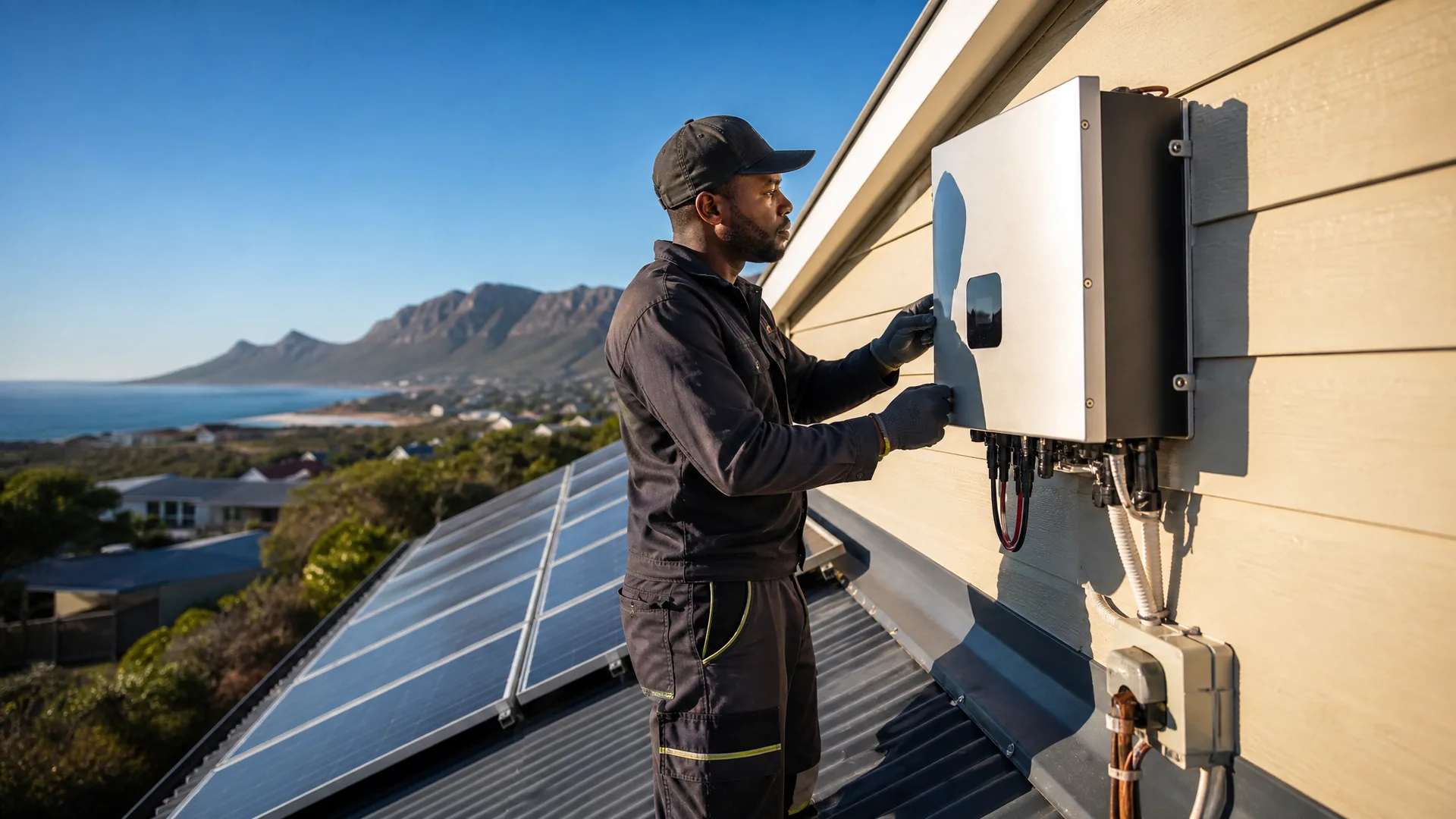
Solar power in South Africa often gets sold as one product, but it comes in different shapes. A grid-tied solar system is one of the most affordable ways for Garden Route homes and businesses to cut electricity bills. It’s also the option that causes the most confusion when load-shedding hits. This guide breaks down how a grid tied solar system in South Africa actually works, what it costs, what municipalities require, and when it makes more sense to go hybrid instead.
What Is a Grid-Tied Solar System and How Does It Work in South Africa?
A grid-tied solar system connects your solar panels directly to the municipal or Eskom grid. There’s no battery in between. During daylight hours, your panels generate power. That power feeds your home or business first, and any surplus flows out to the grid through your existing electrical connection.
At night, or whenever your panels aren’t producing enough, you draw power from the grid as normal. There’s no battery to switch over to and no backup during an outage. The system works only when the grid is live.
This setup makes a grid-tied solar system for homes in South Africa one of the simplest and most cost-effective ways to lower monthly electricity costs. It also means the system offers zero protection against load-shedding or unplanned outages. That’s the trade-off at the heart of this guide.
Grid-Tied Solar Inverter South Africa: The Core Component
The grid-tied solar inverter is the piece that makes the whole system legal and functional. It converts the DC power from your panels into usable AC power. It also syncs that power with the grid’s voltage and frequency.
If the grid goes down, a grid-tied inverter shuts off automatically. This is a safety requirement, not a fault. It stops your system from feeding power into a line that utility workers might be repairing. It’s also why a grid-tied system offers no backup during load-shedding, unlike a hybrid setup that layers in battery storage and switching logic. For a closer look at how these components differ, the different types of solar inverters used in South Africa is worth reading before you commit to a design.
Grid-Tied vs Hybrid Solar in South Africa: An Honest Comparison for Load-Shedding-Prone Areas
The grid tied vs hybrid solar debate in South Africa isn’t about which system is better. It’s about which trade-off suits your situation. Grid-tied systems cost less to install and pay back faster. Hybrid systems cost more upfront but keep your lights, fridge, and Wi-Fi running when the grid drops.
For Garden Route properties, where outages can come from load-shedding or from storm-related grid faults, this decision carries real weight. Neither option is wrong. They solve different problems.
Solar System Without Battery South Africa: What You Give Up
A solar system without a battery in South Africa still delivers meaningful daytime savings. What it doesn’t deliver is resilience. When the grid is down, your solar panels are also down, even if the sun is shining.
For many households, this is an acceptable trade-off, especially where outages are short and infrequent. For businesses running fridges, servers, or security systems, an outage without backup can be costly regardless of how much you’re saving during the day. If backup power matters more to you than lowest cost, it’s worth understanding how a hybrid solar system combines battery and grid backup before finalising your decision.
Grid-Tied Solar Pros and Cons for Garden Route Properties
The pros of grid-tied solar are straightforward. It’s the cheapest way to install solar, it has fewer components to maintain, and it pays back faster than hybrid or off-grid systems.
The cons are just as clear. There’s no power during outages, no battery to store excess daytime generation for evening use, and limited ability to sell surplus power back to the grid in most areas.
For Garden Route homeowners weighing grid-tied solar pros and cons, the real question is how much daytime power you use, how often your area loses grid power, and how much you’re willing to spend to remove that risk entirely.
Grid-Tied Solar Cost and Payback Period in South Africa for 2026
Grid-tied solar cost in South Africa varies with system size, panel quality, and inverter brand. It stays lower than hybrid or off-grid alternatives because there’s no battery bank to fund. Removing the battery is typically the single biggest cost saving in the entire installation.
Payback periods depend on how much of your daytime consumption the system offsets and how your municipality structures its tariffs. A Garden Route household replacing a large share of its daytime municipal supply with a correctly sized grid-tied system can offset a substantial portion of its bill. The exact figure depends on usage patterns and the specific tariff structure in place.
Businesses trading standard daytime hours, such as retailers or small manufacturers, tend to see faster payback than households. Their heaviest usage lines up directly with peak solar generation. For a property-specific view, a full breakdown of solar installation costs in the Garden Route gives more granular figures, while typical solar panel cost ranges across South Africa offers useful national context for comparison.
How Rising Eskom Tariffs Improve the Payback Case
Eskom’s tariff increases in recent years have consistently outpaced inflation. Every increase pushes up the value of every unit your solar system generates instead of buying from the grid. A grid-tied system installed in 2026 pays itself back faster than an identical system installed two or three years ago, simply because the electricity it’s replacing now costs more.
This trend is likely to continue into 2027 and beyond as tariffs keep climbing. It’s one of the clearest arguments for locking in solar sooner rather than later. It’s also worth checking renewable energy tax incentives that can offset installation costs, which can shorten payback further depending on your circumstances.
Municipality Solar Approval and Grid Connection Requirements in the Garden Route
Solar grid connection in South Africa isn’t a plug-and-play process. Every grid-tied system feeding power toward the municipal network needs formal approval before it can legally connect. This protects the grid, protects utility workers, and protects you from insurance and compliance headaches later.
Municipality solar approval requirements in South Africa vary by region, and the Garden Route is no exception. Municipalities across the area, including those governing George, Mossel Bay, and Knysna, generally require a registered electrician’s certificate of compliance and an approved inverter changeover switch before allowing a grid-tied connection. Some also require a formal application, a small-scale embedded generation registration, or proof that your inverter meets specific technical standards.
Turnaround times differ from one municipality to the next, and they can shift as departments update their processes. Everlife Group’s installation teams work directly with Garden Route municipalities on grid-tied approval submissions. That gives clients a clearer sense of realistic local turnaround times than generic national guides can offer.
Steps to Get a Grid-Tied System Installed and Approved
Getting a compliant grid-tied system typically follows a similar sequence, though the details shift depending on your municipality:
- A site assessment to confirm roof suitability, orientation, and daytime usage patterns.
- System design and sizing based on your consumption and available roof space.
- Installation by a registered electrician, including the changeover switch.
- Certificate of compliance issued after installation.
- Submission of the municipal application, with supporting documents.
- Final inspection or sign-off, depending on the municipality’s process.
Before starting, it’s worth calculating the right system size for your property so your application matches what you actually need, rather than guessing at capacity.
On net metering in South Africa: most municipalities don’t yet offer true net metering, where excess power earns a credit or payment. Some allow limited feed-in under specific tariff structures, but this is far from universal along the Garden Route. In practice, most grid-tied systems are designed to minimise export rather than rely on selling power back. That’s another reason accurate sizing matters more than overbuilding capacity.
When Grid-Tied Solar Makes Sense, and When It Doesn’t
Grid-tied solar for the home in South Africa makes the most sense when your household or business uses a lot of power during the day, your area has a reasonably stable grid, and your main goal is lowering monthly bills rather than eliminating outage risk.
It’s a strong fit for budget-conscious buyers who want the fastest payback and the simplest installation. It also suits daytime-heavy commercial operations, where energy use lines up neatly with solar generation hours.
It makes less sense for households or businesses in areas with frequent or extended outages, where losing power during load-shedding causes real disruption or financial loss. In those cases, the upfront cost of hybrid buys something grid-tied simply can’t: continuity when the grid fails. If backup capability is a priority, adding battery backup to a home solar setup is the logical next step to explore, and it doesn’t always mean starting over.
How Everlife Group Guides Clients Through Design, Approval, and Installation
Choosing between grid-tied and hybrid solar isn’t a decision you should have to make alone, and it isn’t one-size-fits-all across the Garden Route. Every property has a different roof, usage pattern, and municipal process to navigate.
Everlife Group works with homeowners and business owners across the region to size systems correctly, prepare the paperwork municipalities require, and manage installation from start to finish. That includes handling certificate of compliance requirements, changeover switch installation, and the specific approval steps used in George, Mossel Bay, Knysna, and neighbouring municipalities.
For business owners weighing the numbers more closely, the ROI-focused commercial solar installation guide covers how commercial payback timelines typically compare to residential ones.
If you’re weighing grid-tied solar in the Garden Route against a hybrid setup, the clearest way forward is a proper site assessment. Request a free assessment and quote from Everlife Group, and get a straight answer on which system fits your property, your budget, and your municipality’s rules.