
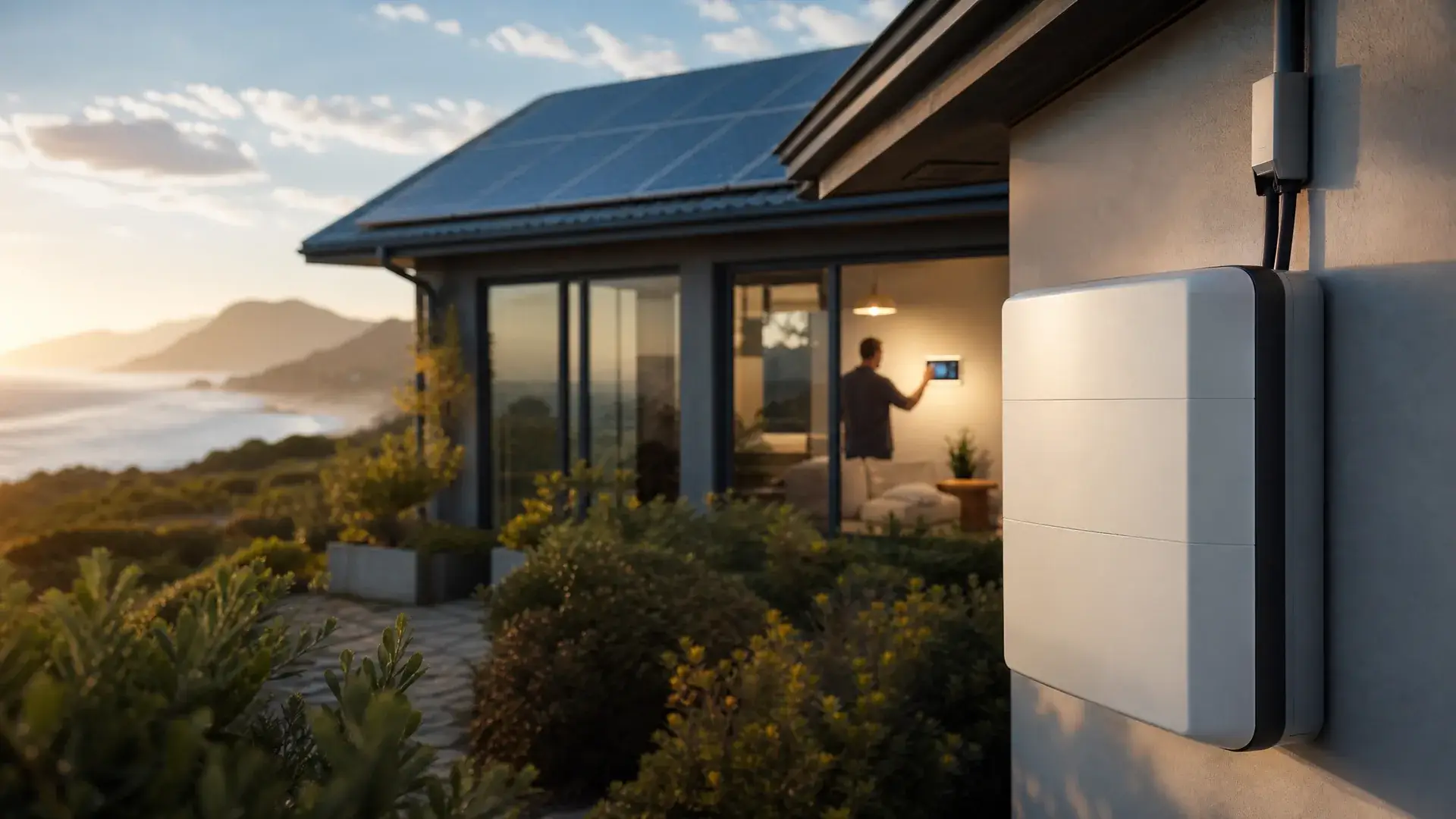
Load-shedding doesn’t ask permission, and neither does a power outage on a stormy Garden Route night. If you already have solar panels, or you’re planning your first installation, the question that decides how much independence you actually get is simple: what battery backup are you pairing with it? This guide walks through sizing, chemistry, cost, and how to choose an installer you can trust, written specifically for homeowners, not commercial or off-grid operators.
Why Home Battery Backup Is a Different Game From Commercial Storage
Commercial battery storage is built around industrial load profiles, three-phase supply, and budgets that can absorb oversizing. A home is a different problem. You’re not trying to keep a factory line running. You’re trying to keep the lights on, the fridge cold, and the Wi-Fi router alive while load-shedding stages roll through the schedule.
That means solar battery backup for home in South Africa needs to be sized around your household’s actual daily habits, not a generic commercial template scaled down. A system that’s too small leaves you in the dark during longer stages. One that’s too large adds cost you don’t need.
Garden Route homes add a few local quirks to the equation. Coastal humidity and salt air affect equipment durability, and some areas sit further from substations, which can mean longer restoration times once load-shedding ends or storms knock out lines. Everlife Group has installed solar and battery backup systems for homeowners across the Garden Route, which gives direct insight into which battery sizes hold up against real regional load-shedding patterns rather than theoretical averages.
What load-shedding independence really requires at home
Independence during load-shedding doesn’t mean running your whole house exactly as if the grid were up. It means keeping essential circuits alive through every stage your municipality throws at you, reliably, for as long as an outage lasts. That’s a narrower, more achievable goal than full energy self-sufficiency, and it’s the right starting point for most homeowners before considering anything bigger.
Understanding Battery Capacity: What It Actually Powers in Your Home
Battery specs get confusing fast because two different units are doing two different jobs. Capacity, measured in kWh, is how much energy the battery can store, think of it as the size of the tank. Power output, measured in kW, is how much of that energy the battery can deliver at once, the size of the tap. A battery can have plenty of capacity but still trip if you ask it to run several high-draw appliances at the same time.
How many batteries for home solar do you actually need
There’s no single number that fits every home, and anyone who gives you one without asking about your usage first isn’t sizing your system properly. The real answer depends on which appliances you want backed up, for how many hours, and through how many load-shedding stages a day. A retired couple in a two-bedroom home with LED lighting and a small fridge needs far less than a household running a home office, multiple fridges, and evening cooking on electricity. The honest way to answer this is to work backward from your actual loads rather than forward from a battery count, and you can calculate your solar system size before committing to a battery bank.
Solar battery capacity for home: matching kWh to appliances
Think of your home’s loads in two tiers. The first tier, fridges, freezers, lighting, Wi-Fi, phone charging, a TV, draws relatively little power and is the easiest and cheapest to back up. The second tier, pool pumps, geysers, air-conditioning, ovens, draws far more, and backing these up on battery pushes your capacity requirement up considerably. A typical Garden Route household running fridges, lighting, Wi-Fi, and a few small appliances through load-shedding stages needs meaningfully less battery capacity than one also trying to run a pool pump, geyser, or air-conditioning on backup. Deciding upfront which tier you actually want covered is the single biggest factor in getting your solar battery storage for house sizing right.
LiFePO4 vs Lead-Acid vs Lithium-Ion: An Honest Comparison for SA Homeowners
The best battery for solar at home question comes down to a trade-off between upfront cost, lifespan, and how the battery behaves over years of daily cycling.
Lead-acid batteries are the cheapest to buy upfront, and that’s their main appeal. They don’t like being discharged deeply or often, which shortens their usable life considerably in a load-shedding context where they’re cycling most days. They’re also bulkier and need more ventilation and maintenance than modern alternatives.
Lithium-ion covers a broad family of chemistries, and general consumer lithium-ion (the kind in laptops and phones) isn’t typically what goes into home battery backup. For stationary home storage, the chemistry that matters is LiFePO4, lithium iron phosphate, a subtype of lithium-ion built specifically for safety and longevity in fixed installations.
Why lithium battery backup south africa buyers are moving to LiFePO4
LiFePO4 batteries generally support several thousand charge cycles and hold their capacity far longer than lead-acid alternatives. That’s why most reputable installers in South Africa now default to lithium chemistries for home backup. They also tolerate deeper, more regular discharge without the same rapid degradation lead-acid shows, which matters when load-shedding means daily cycling rather than occasional emergency use.
Lifespan and safety trade-offs
LiFePO4 is also more thermally stable than other lithium-ion chemistries, so it carries a lower risk of thermal runaway. That matters for a battery sitting in a garage or utility room. Lead-acid remains viable for very light, occasional backup needs on a tight budget, but for most Garden Route homes planning to lean on their battery regularly, LiFePO4 is the chemistry installers recommend. For a closer look at how different products stack up, the best solar battery storage options in South Africa breaks down specific models and their specifications.
What a Solar Battery System Costs in South Africa in 2026
There’s no getting around it: battery storage is usually the single biggest line item in a home solar and battery package, often costing more than the panels themselves. Solar battery cost south africa figures vary widely because the inputs vary widely, capacity, chemistry, brand, inverter compatibility, and installation complexity all move the number.
A small battery system sized for essential circuits only sits at the lower end of the market. A larger bank designed to cover most of the home’s daily usage, including higher-draw appliances, costs considerably more. Brand tier matters too. Established, warrantied LiFePO4 systems from reputable manufacturers cost more upfront than budget alternatives, but they tend to offer longer cycle life and stronger after-sales support.
Solar battery cost south africa: what drives the price up or down
Several factors push the price in either direction. Capacity is the obvious one, more kWh costs more. But installation complexity matters almost as much: retrofitting a battery onto an existing inverter setup can require additional wiring, a compatible inverter upgrade, or even a full inverter swap if the existing unit can’t communicate with the battery. Warranty length and manufacturer support also factor into price, and they’re worth paying for rather than skimping on.
Homeowners weighing upfront cost against long-term value should treat battery backup as an investment in reliability, not just a load-shedding workaround. Cycle life and warranty support matter more than sticker price over a 10-year horizon. For a fuller cost breakdown specific to the region, see Garden Route solar installation costs, and for panel-only pricing context, the overall solar panel cost ranges in South Africa is a useful comparison point.
Sizing and Pairing Your Battery With an Existing Solar or Inverter Setup
If you already have solar panels and an inverter, adding a battery doesn’t necessarily mean starting over, but it does mean checking compatibility first. Some inverters are hybrid-ready and can accept a battery with minimal extra work. Others are grid-tied only and will need an upgrade or replacement before a battery can be added at all.
Solar and battery package south africa: new installs vs retrofits
For homeowners installing solar and battery together from scratch, a hybrid system built around both from day one is usually the cleanest and most cost-effective route. Everything is sized and matched at once. For retrofits, the priority is confirming your existing inverter can communicate with the battery chemistry you want, particularly LiFePO4. If it can’t, budget for an inverter upgrade as part of the project rather than an afterthought. Understanding which inverter type suits your setup is worth doing before you shop for a battery, since the two decisions are linked. For those wanting the two working together as a single coordinated system, hybrid solar systems that combine battery storage and grid connection explain how that integration works in practice.
Load shedding battery backup home: partial vs full-home coverage
Decide early whether you want partial coverage, essential circuits only, on a dedicated backup board, or full-home coverage, where the battery can carry the entire property’s load. Partial coverage is cheaper, simpler to install, and covers what most households actually need during load-shedding. Full-home coverage costs more but means you never have to think about which switch is on the backup board. Most Garden Route homeowners find partial coverage delivers the practical independence they’re after without the added expense of full-home capacity.
Load-Shedding Independence vs Full Off-Grid: Knowing the Difference, and Choosing a Trustworthy Garden Route Installer
These two goals get conflated often, but they call for very different systems. Load-shedding independence means your battery bridges the gaps in grid supply: it charges from solar and the grid, and discharges during outages, but you remain connected to the municipal grid the rest of the time. Full off-grid means disconnecting from the grid entirely and relying on solar and battery storage for everything, every day, in every season. Off-grid systems need considerably more panel capacity and battery capacity to handle winter and cloudy stretches without a grid to fall back on. Almost all Garden Route homeowners are better served, and better matched to their budget, by a load-shedding-focused system rather than full off-grid.
How long does a solar battery last, and how to vet an installer
A well-specified LiFePO4 battery, properly installed and not routinely over-discharged, is generally expected to hold meaningful capacity for many years of daily cycling before performance drops enough to warrant replacement. Actual lifespan depends on how hard the battery is cycled, ambient temperature, and installation quality, which is exactly why the installer matters as much as the battery brand.
When vetting a Garden Route installer, look for accreditation with recognised industry bodies, a track record of local residential installations (not just commercial projects), and clear, honest answers about warranty terms. Ask directly how warranty claims are handled if something goes wrong. Understanding how solar warranty claims work in South Africa will help you spot an installer who stands behind their work versus one who disappears after the invoice is paid. Local reputation counts for more than a national ad campaign: ask for references from homeowners in your own area who’ve been through actual load-shedding stages with the system, not just a showroom demo.
Getting the sizing, chemistry, and installer choice right up front saves years of frustration and cost down the line. If you’re ready to move from research to a system built around your actual home, Everlife Group can assess your property and put together a personalised solar battery backup quote for your Garden Route home.